Advances in Engineering Advances in Engineering features breaking research judged by Advances in Engineering advisory team to be of key importance in the Engineering field. Papers are selected from over 10,000 published each week from most peer reviewed journals.

Journal of Fluids and Structures, Volume 48, 2014, Pages 93–102. Luis Antonio Rodrigues Quadrante, Yoshiki Nishi.
Department of Systems Design for Ocean-Space, Faculty of Engineering, Yokohama National University, 79-5 Tokiwadai, Hodogaya, Yokohama 2408501, Japan
Abstract
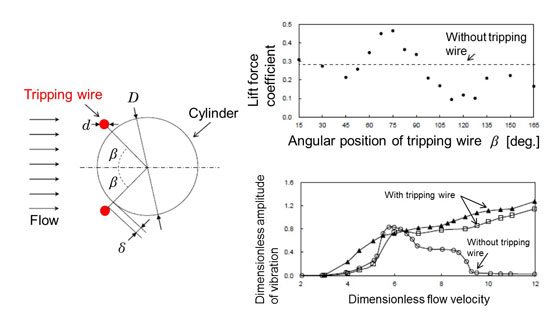
This study has experimentally studied the effect of tripping wires on the vibration of a circular cylinder subject to flows. We placed a pair of tripping wires onto the surface of a circular cylinder symmetrically about the stagnation point, and submerged the cylinder clamped or elastically mounted. The test for the clamped cylinder (hereinafter stationary cylinder test) covered a wide domain of angular position from 15° to 165° to find what angular positions enhance or weaken hydrodynamic forces acting on the cylinder. The test for the moving cylinder used four angular positions: 60°, 75°, 105° and 120° to examine how the tripping wires amplify or suppress the flow-induced vibration of the cylinder. The stationary cylinder test revealed that with the angular position ranging from 20° to 52.5° or greater than 97.5° the hydrodynamic forces diminish and with the angular position ranging from 52.5° to 97.5° the forces increase. Particularly, positioning the tripping wires at 75° maximally increases the lift and drag coefficients by 63% and 44%, respectively, in comparison with the coefficients produced without the tripping wires, and these coefficients are maximally reduced by 67% and 20%, respectively, by positioning them at 112.5°. The moving cylinder test has elucidated that the angular positions at 60° and 75° intensify the vibration of the cylinder, involving a monotonic increase in the amplitudes with an increase in reduced velocity and wide lock-in range. With the tripping wires attached at 105° and 120° the vibrations of the cylinder are considerably suppressed, particularly when the angular position is 120° the vibration completely disappears.