Advances in Engineering Advances in Engineering features breaking research judged by Advances in Engineering advisory team to be of key importance in the Engineering field. Papers are selected from over 10,000 published each week from most peer reviewed journals.

Significance
Aluminum alloys have unique material characteristics such as high thermal conductance, good recyclability, and high corrosion resistance, which make them ideal for applications in lightweight vehicles that are designed to reduce carbon emissions and increase fuel economies. However, aluminum alloys have a low formability, which limits their applications in the automotive industry.
Hot stamping is a forming method that has been introduced in recent years for forming sheet metal components at high temperatures. During the forming process, the sheet metal is first heated to an elevated temperature, then formed and quenched simultaneously by cold dies at high speed.
To retain the mechanical integrity of the material during the post-forming ageing process, the rate of quenching in the hot stamping process should be above the critical cooling rate so that no solutes precipitate as coarse particles.
The interfacial heat transfer coefficient is a thermal-physical parameter that should be determined in hot stamping processes to retain the mechanical integrity of the formed elements, by tuning the quenching process to achieve the critical rate of cooling and optimize the rate of production.
Researchers led by Dr. LiLiang Wang at Imperial College London developed an experimental facility and implemented it to determine the temperature evolution of tools and specimens at various contact pressures under lubricated and dry conditions. This facility was designed with interchangeable components and streamlined the process through which the interfacial heat transfer coefficient between various combinations of blank as well as tool materials could be established. This research work is conducted jointly with Schuler Pressen GmbH and published in Journal of Materials Processing Technology.
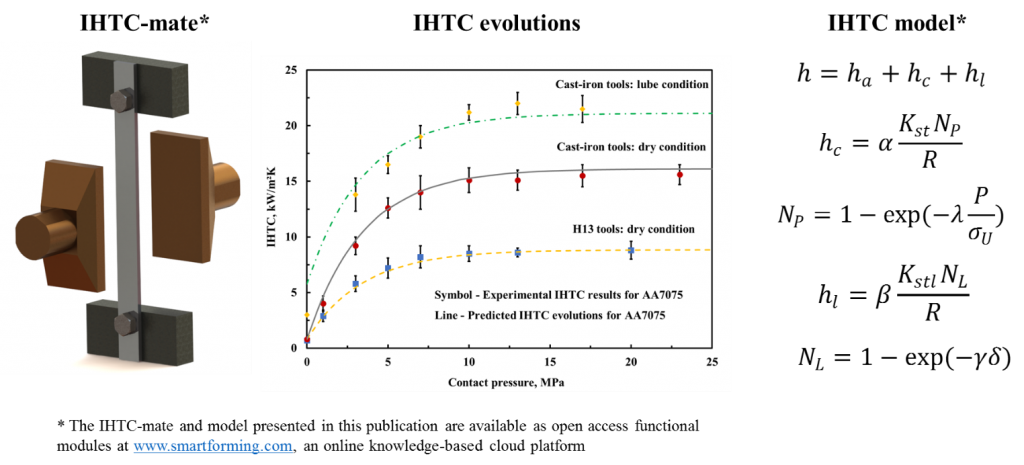
The authors used the dedicated interfacial heat transfer coefficient test facility ‘IHTC-Mate’ to establish temperature evolutions of AA7075 blanks that were thereafter fit to modelled temperature evolutions established in the FE software PAM-STAMP. They then applied a graphite lubricant onto the tools’ surfaces in order to investigate the effect of lubrication on the interfacial heat transfer coefficient.
The research team established, under lubricated and dry conditions, an exponential relationship between contact pressure and the interfacial heat transfer coefficient. Under dry conditions, the coefficient value increased significantly with increasing contact pressure and remained stable at 8.6kW/m2K at 13MPa contact pressure for H13 tools. When cast iron tools were used under dry conditions, the coefficient value plateaued at 15.1kW/m2K at 13MPa contact pressure. The coefficient peak value was observed to rise by 46% when graphite lubricant was applied.
The authors also observed that the interfacial heat transfer coefficient increased exponentially with increasing lubricant layer thickness. However, when the lubricant layer thickness was more than 0.015mm, the coefficient value remained constant at varying contact pressures.
The interfacial heat transfer coefficient test facility and numerical model proposed in the study provide an effective method of estimating interfacial heat transfer coefficient evolutions as a function of lubricant, tool materials, and contact pressure.






Reference
Xiaochuan Liu, Kang Ji, Omer El Fakir, Haomiao Fang, Mohammad M. Gharbi, LiLiang Wang. Determination of the interfacial heat transfer coefficient for a hot aluminium stamping process. Journal of Materials Processing Technology, volume 247 (2017), pages 158–170.
Go To Journal of Materials Processing Technology