Advances in Engineering Advances in Engineering features breaking research judged by Advances in Engineering advisory team to be of key importance in the Engineering field. Papers are selected from over 10,000 published each week from most peer reviewed journals.

Significance
Alloys have significantly contributed in the development of strong yet light parts for both automotive and aeronautical use. In particular, hypo-eutectic Aluminum-Silicon (Al-Si) alloy system that exhibit strong corrosion resistance, good castability and relatively high strength-to-weight ratio has been widely adopted. Unfortunately, despite having such excellent and desirable attributes, hypo-eutectic Al-Si alloys have limited usage as structural materials mainly due to the inherent characteristics of the Si phase that forms within its eutectic structure. The Si related flaws in Al-Si alloys lead to brittleness consequently reducing ductility and mechanical property performance. Literature has it that it is possible to modify the Si into a fibrous and rod-like shape, which can yield a 50% improvement in the tensile strength, and a three-fold improvement in the ductility. Further, the aforementioned non-ideal Si morphology can be modified, via alloy additions and/or rapid solidification, but the underlying mechanism(s) behind this is poorly understood.
In this view, it would be desirable if one focused on hypo-eutectic systems rather than the polar eutectic/hypereutectic alloy compositions. To this end, a group of researchers from the Department of Chemical and Materials Engineering at University of Alberta: Mr. William Hearn, Dr. Abdoul-Aziz Bogno, Dr. Jonas Valloton and Professor Hani Henein together with Professor Jose Spinelli at Federal University of São Carlos investigated the microstructural evolution of rapidly solidified hypo-eutectic Al-10 wt pct Si alloys, using Impulse Atomization (IA) (a drop tube technique) and Differential Scanning Calorimetry (DSC) techniques. They developed microstructure maps of the eutectic structure to define what solidification rates would cause shifts in the Si morphology. Their work is currently published in the research journal, Metallurgical and Materials Transactions A.
To begin with, the researchers produced Al-10 wt pct Si alloys by induction melting of commercial purity Al and high purity Si. Various thermal histories were obtained by IA (high cooling rate and large undercooling) and by DSC. After processing, the resultant alloy was subjected to metallographic analysis, X-ray diffraction among other intricate analysis procedures. Moreover, so as to characterize the mechanical properties of the resultant Al-10 wt pct Si alloy, the researchers carried out Vickers hardness measurements.
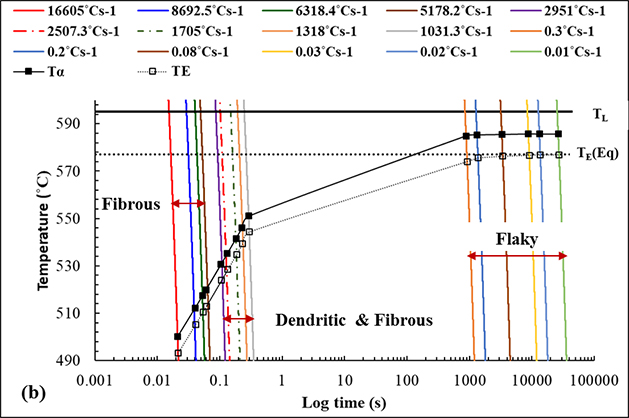
The authors found out that the eutectic Si formed into four distinct morphologies: flaky, dendritic, dendritic & fibrous and fibrous (Figure 1), depending on the solidification conditions. As a result, the researchers proposed two solidification maps of the Si morphology; one based on local eutectic solidification conditions (Figure 2) and another based on a solidification continuous cooling diagram (Figure 3). Finally, the results of the hardness measurements (converted into Yield Strength, σYS, by using a widely used polycrystalline materials strength-hardness relationship: σYS= 3×Hv) carried out showed that the Si morphology influenced the alloys’ strength, with the highest value being achieved when the eutectic Si was fibrous (Figure 4).
In summary, University of Alberta scientists successfully generated various thermal histories for Al-10 wt pct Si alloys by impulse atomization and Differential Scanning Calorimetry. Generally, a thorough analysis of the micrographs confirmed the expected solidification microstructure, consisting of a pro-eutectic α-Al phase and an α-Al + Si eutectic structure. Overall, in a statement to Advances in Engineering, Dr. Abdoul-Aziz Bogno emphasized that the Si morphology remains an important factor that could alter the mechanical properties of hypo-eutectic Al-Si alloys.




Reference
William Hearn, Abdoul-Aziz Bogno, Jose Spinelli, Jonas Valloton, Hani Henein. Microstructure Solidification Maps for Al-10 Wt Pct Si Alloys. Metallurgical and Materials Transactions A, Volume 50, Issue 3, page 1333–1345.
Go To Metallurgical and Materials Transactions A