Advances in Engineering Advances in Engineering features breaking research judged by Advances in Engineering advisory team to be of key importance in the Engineering field. Papers are selected from over 10,000 published each week from most peer reviewed journals.

Significance Statement
Gas-liquid co-current up-flow packed beds are normally applied as reactors and multiphase contactors in chemical processes that necessitate a contact between solid, liquid and gas phases. Alkylation, hydrogenation, wastewater treatment and oxidation are a few processes that implement this type reactor owing to cheap operations and simple construction. Above all, high liquid residence time, superior interphase heat and mass transfers are also a few benefits that come with co-current up-flow packed bed reactors.
However, complexities in hydrodynamics of these reactors and the need for reliable designs and scale-up for industrial applications have attracted significant research works. While some studies focus on experimental methods to analyze the hydrodynamics such as bubble characteristics, flow regime, back mixing and pressure drop, a few have focused on the development of mathematical models to approximate these hydrodynamic parameters.
The effects of ship rotational as well as translational oscillations on the hydrodynamic characteristics of co-current up-flow packed beds have not been investigated. Therefore, researchers led by Professor Faïçal Larachi from Laval University in Canada, in their work, offered some insights into the hydrodynamic characteristics of up-flow packed bed reactors for off-shore floating platforms. They examined these characteristics in terms of liquid saturation, pulse flow regime, pressure drop, and phase distribution using hexapod motion simulator and wire mesh sensors. Their work is published in peer-reviewed journal, Chemical Engineering Science.
For laboratory-scale hydrodynamic analyses, the authors did the experiments using water and air operated in a co-current up-flow mode. They adopted a column packed with glass beads positioned on a hexapod ship motion simulator that was able to emulate single as well as multiple degrees of freedom; both rotational and translational. They embedded in the bed wire mesh sensors in order to record variations in instantaneous liquid saturation and characterize their flow characteristics during bed excitations.
The authors used Aris’s two-point deflection and tracer signal analysis methods to determine the Peclet number. Also, residence time distribution analysis enabled them to determine the liquid mean residence time.
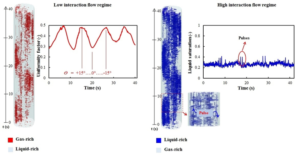
They observed that the column deviation from the mean position greatly affected the hydrodynamics of the packed bed operating in an up-flow mode. Oscillations initiated noticeable effects on the bed gas-liquid distribution and pressure drop. While tilting motions caused significant oscillations in the uniformity factors and pressure drops, the non-tilting motions augmented the parameters with minor fluctuations only. When they increased the tilt angle of the stationary bed, they recorded a drop in the Peclet Number and augmented liquid residence time owing to the creation of gas-liquid disengagement zones.
Tilting oscillations limited gas-liquid interactions based on gravity driven flows inside the beds that resulted in a delay in the initiation of pulse flow regime. Also, a rolling period of about 20 seconds displayed a pulse flow regime which coincided with the straightening of the column in the course of oscillations. Liquid velocity intensified the gas-liquid interaction which led to the formation of even more pulses for roll and pitch motions.



Reference
Amir Motamed Dashliborun1, Faïçal Larachi1, and Markus Schubert2. Hydrodynamics of gas-liquid co-current up-flow in oscillating packed beds for offshore marine applications. Chemical Engineering Science Available online 25 December 2016.
[expand title=”Show Affiliations”]- Department of Chemical Engineering, Laval University, Québec, QC G1V 0A6, Canada
- Helmholtz-Zentrum Dresden-Rossendorf, Bautzner Landstraβe 400, 01328 Dresden, Germany
Go To Chemical Engineering Science