Advances in Engineering Advances in Engineering features breaking research judged by Advances in Engineering advisory team to be of key importance in the Engineering field. Papers are selected from over 10,000 published each week from most peer reviewed journals.

Significance
Generally, oil reserves denote the amount of crude oil that can be technically recovered at a feasible cost. The output of oil wells in any given oil field irreversibly dwindle with continued extraction with time. In the US, tremendous growth in the production of tight oils and shale gas has resulted in the continued decline in the quantity of legacy Pennsylvania grade crude oil. The latter coupled by volatile crude oil prices has prompted American Refining Group (ARG) to initiate processing of a wide variety of discounted opportunity crudes in a bid to expand its crude oil feedstock slate to maintain profit margins.
Opportunity crudes are less expensive and more readily available than traditional crudes and possess various properties that may vary significantly. As opportunity crude usage increases, crude oil fouling and unexpected corrosion have become major issues in the refinery crude unit’s hot heat exchanger train (HHET) and other process units. Consequently, crude oil fouling in the refinery has resulted in increased energy consumption, reduced throughput, and more frequent shutdowns. There exist an array of studies demonstrating the effects of opportunity crudes from various geological formations, however, little information exits on the impact of opportunity crude variation in composition, blended with Pennsylvania (PA) grade paraffinic crude oil, on the crude unit (CU) hot heat exchanger train fouling.
To date, ARG has had no reported major coking or fouling issues with refinery process units while processing 100% Pennsylvania grade legacy crude oil. However, since the introduction of various opportunity crudes, a myriad of process challenges in the refinery the result in frequent crude unit turnarounds (TARs)/heat exchanger cleanouts and greater production losses. To this note, a group of researchers from the Research & Development Department, American Refining Group, Inc. in Pennsylvania: Prafulla D. Patil, Mike Kozminski, John Peterson and Sailesh Kumar, evaluated the interpretation of crude unit hot heat exchanger train effectiveness based on opportunity crudes in the crude blend. Their work is currently published in the research journal, Industrial & Engineering Chemistry Research.
Generally, fouling at the refinery crude unit HHET resulting from the impact of Pennsylvania grade crude blended with opportunity crude oils was investigated. The researchers studied thermal and hydraulic fouling models in a bid to detect changes in the fouling behavior of the crude unit’s hot heat exchanger train. In their study, various crude oil fouling diagnostic tools were used to determine the root causes of fouling including foulant chemical characterization, crude oil compatibility, caustic injection evaluation, crude furnace operation, crude corrosion, and in-house developed fouling indices.
The authors reported that the percentage effectiveness of the crude unit heat exchanger train decreased significantly with the introduction of Utica and Michigan crudes at higher rates. Moreover, at controlled optimized rates in the crude blend, Ontario and New Mexico crudes showed a positive influence on the crude oil fouling rate reduction trend. With the exception of the substandard Kentucky crude which revealed high Insolubility number (IN =8), the oil compatibility model (OCM) indicated that all other tested crudes had an insolubility number of “0”, which inferred that they were all compatible with Pennsylvania grade crude in all proportions
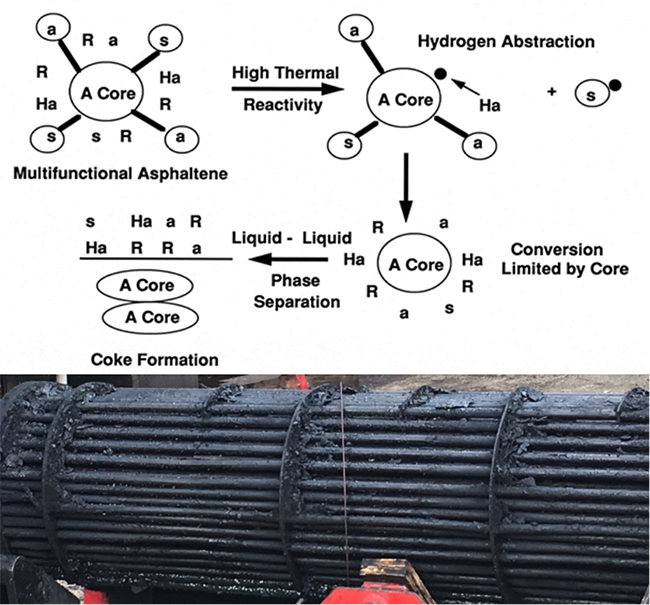
In summary, the impact of opportunity crudes (Utica, Michigan, Kentucky, Ontario, New Mexico) blended with Pennsylvania (PA) grade legacy crude oil on the refinery crude unit hot heat exchanger train (HHET) fouling was evaluated. The primary fouling factors investigated at the crude unit hot exchanger train were filterable solids/Inorganics present in the opportunity crudes, crude oil incompatibility, velocity driven deposits and thermal degradation. Thermal cracking was detected as the primary cause of the coking issue in the crude tower boot section due to high severity heater and column operation. In an interview with Advances in Engineering, Prafulla Patil highlighted that the simultaneous monitoring of the thermal and hydraulic performance of refinery heat exchangers was crucial to detect the fouling behavior with changing crude oil composition. The research work would be helpful to refinery professionals who are engaged in crude oil evaluation to expand its crude oil feedstock slate for better utilization of refinery assets and maintain profit margins in this volatile crude oil market.




Reference
Prafulla D. Patil, Mike Kozminski, John Peterson, and Sailesh Kumar. Fouling Diagnosis of Pennsylvania Grade Crude Blended with Opportunity Crude Oils in a Refinery Crude Unit’s Hot Heat Exchanger Train. Industrial & Engineering Chemistry Research 2019, volume 5838, page 17918-17927.
Go To Industrial & Engineering Chemistry Research