Advances in Engineering Advances in Engineering features breaking research judged by Advances in Engineering advisory team to be of key importance in the Engineering field. Papers are selected from over 10,000 published each week from most peer reviewed journals.

Significance
The inductive influence of HV transmission lines on different nearby metal installations has been a research subject for at least six last decades. However, until recently developed methods were applicable only in relatively simple cases, when a scenario of right-of-way is very simple and when all relevant data are known. Even in such, relatively simple cases, because of complexity of the problem, a required problem solution frequently cannot be obtained without using modern computers.
The problem becomes extremely complex in the case of HV cable lines because they are, almost without any exceptions, laid in urban or suburban areas, where there are many others, known and unknown, metal installations. The usage of common routes (mainly street pavements) for various supply networks (electricity, water, gas, oil, telecommunications, etc) inevitably leads to their inductive coupling. Since these installations are mainly laid underground, many relevant data about them (constructive characteristic, mutual spatial position, including in some cases even and their total number) are uncertain or completely unknown. Thus, it is obvious that this problem cannot be solved by using only a calculation procedure. Also, the same or similar reasons prevent us to measure currents induced in the surrounding metal installations and the current passing solely through the surrounding earth.
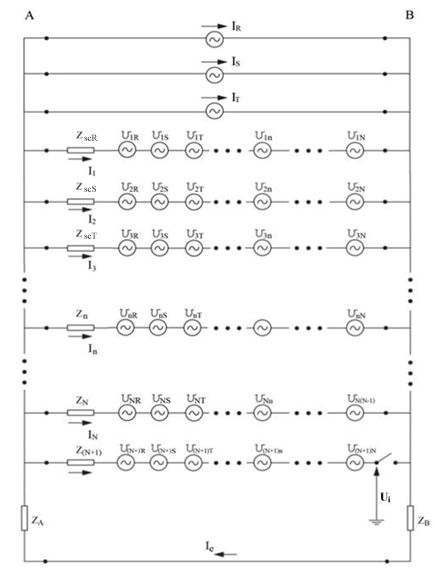
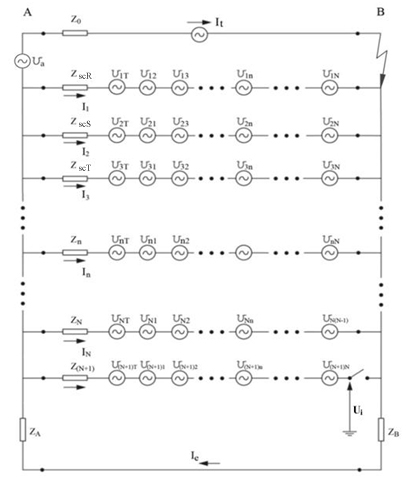
The first method that enables compensation of deficiency of all unknown, but relevant data was developed by Dr. Popovic. The method is based on the measuring of the currents through one phase and through one neutral conductor of the considered HV line during the simulated ground fault in the supplied HV substation. Also, the calculation part of the developed method is based on a fictitious (equivalent) conductor substituting, from the standpoint of their inductive influence, all surrounding metal installations. It is imagined as a cylinder encompassing all conductors of the considered HV line along entire its length. However, this method requires exact measuring of the induced potential at the end of a provisory laid LV cable line that is practically impossible in urban conditions. Thus, this method is applicable only in the case of HV overhead lines.
Dr. Ljubivoje M. Popovic from Beograd (Serbia) managed to solve the problem of the inductive influence of HV cable lines in urban surroundings by developing the new version of its methodology for compensation of deficiency of all relevant but unknown data. The work is published in the journal, Electric Power Systems Research.
By using this version of Popovic’s methodology all necessary measurements are performed only within one of the substations at the line ends. Also, it is shown that the fictitious conductor can be determined in such manner that its physical appearance and spatial position coincide with any of the actual screens of the considered line. Thus, the inductive influence of all surrounding metal installations including the sheaths of the other two single-core cables can be expressed only through one equivalent line parameter, the longitudinal resistivity of one of the screens belonging to the considered cable line. Also, the author has analytically proved that the critical ground fault position from the standpoint of the inductive influence of an HV cable line is always the supplied HV substation. Finally, the most important is the fact that this version of Popovic’s methodology enables determination of inductive influence of HV cable lines in all practically possible situations.
Considering the easy feasibility of the method as it requires only relatively simple field measurements and calculations, Dr. Ljubivoje Popovic in a statement to Advances in Engineering highlighted that his method is also efficient and convenient in the cases when the inducing line is an HV overhead line, i.e. in the cases that are solvable with some of the already existing methods.

Reference
Popovic, Lj. (2019). Inductive influence of HV cable lines in urban and suburban areas. Electric Power Systems Research, 176, 105944.