Advances in Engineering Advances in Engineering features breaking research judged by Advances in Engineering advisory team to be of key importance in the Engineering field. Papers are selected from over 10,000 published each week from most peer reviewed journals.

Significance
Flow through porous media represents an area in fluid dynamics that has wide applications, in both natural and technological fields. To name but a few, it is the process governing the transport of oil, gas and water in oil reservoirs, the flow of non-aqueous phase liquids in contaminated aquifers, or the storage of nuclear or other hazardous wastes. In modern technology, it has been successfully applied in many physical, chemical, thermal and biological processes. This flow problem has been studied empirically for a long time since its formulation in 1856 by Henry Darcy who, first, related the flow rate through the porous bed to the pressure drop across the bed’s sides. Since then, many corrections have the proposed, initially on a pure empirical basis. When the flow through the pores is not too slow, the currently accepted formulation employs a permeability coefficient and a second, inertia-related coefficient, called the Forchheimer coefficient. These two coefficients can be incorporated into a single one, termed the apparent permeability. The possibly anisotropic microstructural features of the porous bed render the apparent permeability a tensorial quantity, in which case the mean flow is not necessarily aligned with the driving pressure gradient across the porous bed.
Recently, scientists at the Institute of Fluid Mechanics of Toulouse, Dr. Nicola Luminari and Professor Christophe Airiau in collaboration with Professor Alessandro Bottaro at the University of Genova, investigated how the direction of the macroscopic pressure gradient, the porosity and the Reynolds number could modify the Darcy and Forchheimer closures arising from a volume-averaged model of a fibrous porous medium. In particular, they focused on a transversely isotropic material composed by parallel fibers of circular cross-section, with one axis of symmetry, a model for example of fluid flow through canopies. Their work is published in the International Journal of Multiphase Flow
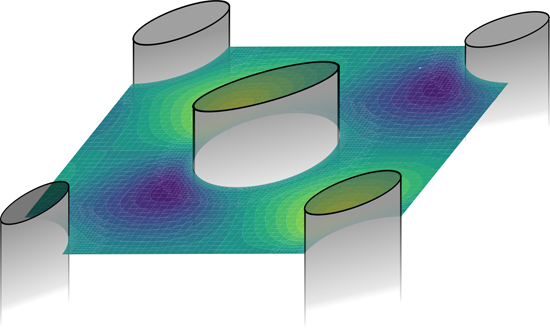
In brief, the work by the research team entailed the consideration of a three-dimensional unit cell for the microscopic model, with a generic non-linear forcing whose direction was defined by two Euler angles. Specifically, they first simulated motion in periodic cells, and then solved successive closure problems leading – after applying an intrinsic averaging procedure – to the components of the apparent permeability tensor. Finally, they identified response parameters in a large parametric space by the use of a metamodel based on kriging interpolation.
The authors observed that the medium, composed of bundles of parallel fibers, favored the deviation of the mean flow towards the fibers’ axis when the driving pressure gradient had even a small component along it, and this was seen to be enhanced by a decreasing porosity. In addition, they noted that, for the over one hundred cases which they simulated, the apparent permeability tensor remained, to a very good approximation, diagonal, a fact mainly related to the transversely isotropic nature of the medium. “This is a nice property”. “since it permits to approximate and simulate complex fibrous media by employing a relatively small number of permeability components.” Said Airiau in a statement to Advances in Engineering.
In summary, Luminari, Airiau and Bottaro solved for the microscopic velocity fields through pores in representative volume elements, by varying forcing amplitude and direction, treating over one hundred different cases of flows through arrangements of parallel fibers. This way, they were able to obtain the components of the apparent permeability tensor. The data point computed directly represented the backbone of a very large data base which was subsequently created by the use of a metamodel. “The data base is freely available on an on-line repository and will be useful for validation purposes by other groups”, states Bottaro, adding that “the computed response surfaces should prove invaluable in determining the force caused by the presence of solid, filamentous inclusions in macroscopic simulations of the flow through bundles of fibers whose orientations and dimensions can vary in space and/or time. The possible applications are countless.”



Reference
Nicola Luminari, Christophe Airiau, Alessandro Bottaro. Effects of porosity and inertia on the apparent permeability tensor in fibrous media. International Journal of Multiphase Flow, volume 106 (2018) page 60–74.
Go To International Journal of Multiphase Flow