Advances in Engineering Advances in Engineering features breaking research judged by Advances in Engineering advisory team to be of key importance in the Engineering field. Papers are selected from over 10,000 published each week from most peer reviewed journals.

Significance Statement
Many civil engineers have resorted to the use of prestressed concrete products reference to their benefits in reducing the overall weight of concrete structures, increased durability, and increased spans. Higher durability of prestressed concrete structures is realized because compressive forces applied to concrete members through the prestressed strands can control cracking due to external loads. This can serve to prevent permeation of harmful components and corrosion of reinforcements.
Reference to the post-tensioned concrete structures, grouting is necessary to protect the steel strands from corrosion. Unfortunately, as a number of researchers has uncovered it, the lifespan of post-tensioned concrete structures is reduced considerably owing to corrosion of strands. This has been identified as the primary cause of collapse of European bridges.
The deterioration of prestressing strands in post-tensioned concrete structures can be referenced to inadequate filling of ducts owing to grout bleeding, which consequently leads to exposure of strands to the atmosphere. This has been identified as the leading cause of chloride ion penetration without the development of cracks. Therefore, a number of international standards have addressed requirements on volumetric changes (settling) and bleeding of grout in a bid to prevent strand exposure. However, ordinary grout has indicated considerable bleeding and does not meet international standards. Therefore, coming up with high-performance grout with near-zero bleeding will be a step towards addressing settling and bleeding problems in post-tensioned concrete structures.
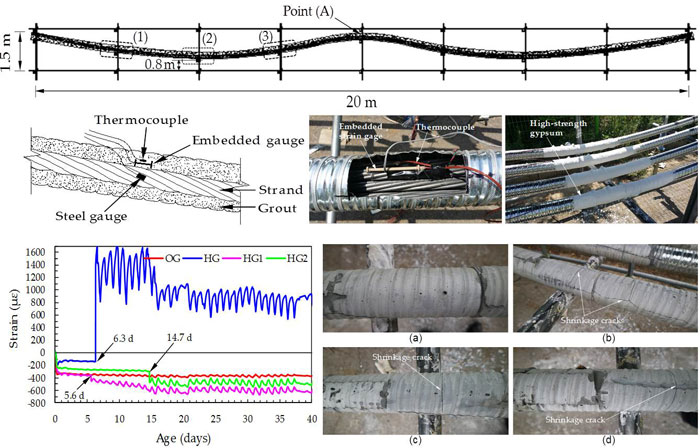
Strands exposure is a major cause of corrosion. However, cracks occurring in grout can lead to grout corrosion reference to permeation of harmful components that reach the prestressed strands through the cracks. When shrinkage of cement-based materials is restrained by reinforcements, cracks can develop perpendicular to the direction of principle stresses. Unfortunately, only a few studies have focused on shrinkage and cracking behavior of restrained posttensioning grout.
Doo-Yeol Yoo at Hanyang University in collaboration with Gum-Sung Ryu and Kyung-Taek Koh at Korea Institute of Civil Engineering and Building Technology and also Tianfeng Yuan at Korea University Republic of Korea developed a high-performance grout indicating low amounts of settling and bleeding. Their objective was to minimize cracking capacity of posttensioning high-performance grout through the inclusion of shrinkage reducing admixture. Their research work is published in peer-reviewed journal, Cement and Concrete Composites.
The authors first prepared high-performance grout exhibiting high fluidity, low settling and bleeding. They subsequently incorporated shrinkage-reducing admixture in the ratio of 1% and 2% by weight to the cementitious inclusions. They also prepared a widely used ordinary grout as a control.
The research team observed that the high-performance grout mixture had identical flowability as the ordinary grout mixture. However, the high-performance grout posted better performance in relation to settling, strength, and bleeding. The inclusion of the shrinkage-reducing admixture to the high performance grout mixture resulted in higher values of tensile and compressive strengths after 28 days. This also resulted in lower maximum internal temperature due to the heat of hydration, delayed shrinkage cracking, and lower shrinkage strain.
The restraint degree reference to uneven surface of duct as well as filling capacity of the high-performance grout was affected insignificantly by the addition of shrinkage-reducing admixture. The authors observed complete filling of ducts for the high-performance grout samples. Ordinary grout mixture showed the smallest shrinkage strain and best performance in relation to shrinkage crack resistance. Unfortunately, ordinary grout led to inadequately filled ducts, which led to exposure of strands.
The authors selected high-performance grout mixture with 2% shrinkage-reducing admixture as the most appropriate posttensioning grout.




Reference
Doo-Yeol Yoo, Gum-Sung Ryu, Tianfeng Yuan, Kyung-Taek Koh. Mitigating shrinkage cracking in posttensioning grout using shrinkage-reducing admixture. Cement and Concrete Composites, volume 81 (2017), pages 97-108.
Go To Cement and Concrete Composites