 Advances in Engineering Advances in Engineering features breaking research judged by Advances in Engineering advisory team to be of key importance in the Engineering field. Papers are selected from over 10,000 published each week from most peer reviewed journals.

Significance Statement
Ionic liquid mediums are continuously being implemented as replacements for hazardous acid-based electropolishing methods. High grade metals are routinely utilized as components of electrochemical treatments. Pure silver finds a wide range of applications in jewelry and coinage. Owing to its electrical and thermal conductivity as opposed to other metals, silver is ideal for electrochemical applications. Above all, silver is antimicrobial and this makes it a good candidate for myriad biomedical uses and a variety of consumer products.
Dr. Jon Derek Loftis and Professor Tarek Abdel-Fattah from Christopher Newport University in Virginia studied the effects of deep eutectic solvents on silver. Their aim was to generate a clean lustrous surface via electrochemical polishing. They employed a conducive ionic liquid treatment comprised of ethylene glycol mixed with quaternary ammonium salts of choline chloride in a 2:1 ratio for electropolishing treatments of high-purity silver metal, and their work is now published in the journal, Colloids and Surfaces A: Physicochemical and Engineering Aspects.
The authors prepared an ionic liquid to polish three silver samples. They adopted small metal samples in order to understand the chemical reactions that occurred within the electrolyte solution. Since the metal sizes varied slightly from one test surface to the next, they set an electropolishing region by restricting electrochemical activity on each piece’s surface using silicone-based tape, and they adopted a platinum anode plate and a silver wire cathode as a reference.
Loftis and Abdel-Fattah observed from voltammetric analysis that setting diffusion at the anode to limit the reaction rate, this gave current potentials necessary for optimizing electropolishing silver metals. After electropolishing, they analyzed the samples’ surfaces to compare the mean surface roughness change. They compared the relative surface roughness and surface morphology of the specimens to industry-produced samples.
The authors recorded a root mean squared surface roughness value of 181.450nm for the as-received silver samples and 31.017nm for the post-treated samples. Comparing the two values, they arrived at 82% smoothing efficiency. Silver possessed the best potential for the optimum electropolishing conditions. Mass loss was also recorded before and after the electropolishing processes. Comparing the samples’ weight before and after the process reveals that silver test pieces experienced the highest surface degradation rate compared to other high-purity metals such as aluminum, nickel, and copper. High electropolishing rates did not translate to a more efficient polish, but were necessary to facilitate a stable low current density for the process to yield the most efficient voltammetric settings.
Drs. Loftis and Abdel-Fattah set up the study with the use of a non-acidic ionic liquid solution to polish pure silver metal samples. The polishing success was validated by an 8× reduction in average roughness of the three silver samples. They noted that low voltage and high current settings coupled with the high electrical and thermal conductivity of silver resulted in pitting and a sub-optimally rough surface. The rate of polishing in pure silver samples was, therefore, linked to electropolishing efficiency. This study demonstrated that the higher the rate of electropolishing, the greater the likelihood of the reduction reaction at the electrode affecting the smoothness of the surface. Therefore, the rate of electropolishing using an ionic liquid definitely has an impact on the resulting surface roughness for silver metal specimens.
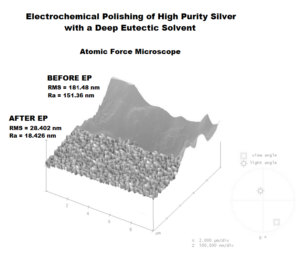 Composite 3D graphic of Atomic Force Microscope roughness assessment of a high-purity silver specimen before and after electropolishing with a recyclable deep eutectic solvent over a 10×10µm recording region.
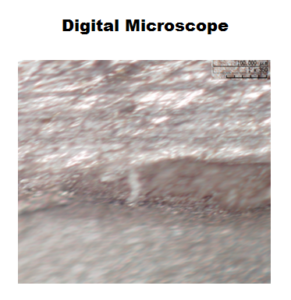 Comparison with digital microscopy observations along the transition zone are depicted below, for reference.


Reference
Jon Derek Loftis and Tarek M. Abdel-Fattah. Nanoscale electropolishing of high-purity silver with a deep eutectic solvent. Colloids and Surfaces A: Physicochemical and Engineering Aspects, volume 511 (2016), pages 113–119
Applied Research Center at Thomas Jefferson National Accelerator Facility and Department of Molecular Biology and Chemistry at Christopher Newport University, Newport News, VA 23606, USA.
Go To Colloids and Surfaces A: Physicochemical and Engineering Aspects