Advances in Engineering Advances in Engineering features breaking research judged by Advances in Engineering advisory team to be of key importance in the Engineering field. Papers are selected from over 10,000 published each week from most peer reviewed journals.

Significance statement
Journal of Polymer Science Part B: Polymer Physics, Volume 52, Issue 1, pages 73–83, 1 January 2014.
Jiaxi Guo1, Yanjun Liu1, Ricardo Prada-Silvy2, Yongqiang Tan2, Samina Azad2,Beate Krause3, Petra Pötschke3 , Brian P. Grady1,4,
- School of Chemical, Biological & Materials Engineering, University of Oklahoma, Norman, Oklahoma.2.
- SouthWest NanoTechnologies Inc. (SWeNT), Norman, Oklahoma.
- Leibniz Institute of Polymer Research Dresden (IPF), Dresden, Germany.
- Corresponding author: Dr. Brian P. Grady
Professor and Douglas and Hilda Bourne Chair in Chemical Engineering
Director, Institute for Applied Surfactant Research
University of Oklahoma
100 East Boyd; SEC Rm. T-223
Norman, OK 73019-0628
http://coecs.ou.edu/Brian.P.Grady/index.html
Abstract
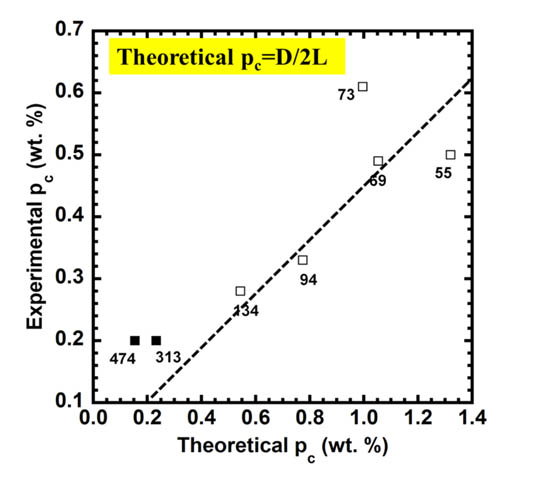
Two multi-walled carbon nanotubes (MWCNTs) having relatively high aspect ratios of 313 and 474 with approximately the same diameter were melt mixed with polycarbonate (PC) in a twin-screw conical micro compounder. The effects of aspect ratio on the electrical, mechanical, and thermal properties of the PC/MWCNT composites were investigated. Electrical conductivities and storage moduli of the filled samples are found to be independent of the starting aspect ratio for these high aspect ratio tubes; although the conductivities and storage moduli are still significantly higher than values of composites made with nanotubes having more commercially common aspect ratios of ∼100. Transmission electron microscopy results suggest that melt-mixing reduces these longer nanotubes to the same length, but still approximately two times longer than the length of commercially common aspect ratio tubes after melt-mixing. Molecular weight measurements show that during melt-mixing the longer nanotubes significantly degrade the molecular weight of the polymer as compared to very similar nanotubes with aspect ratio ∼100. Because of the molecular weight reduction glass transition temperatures predictably show a large decrease with increasing nanotube concentration. © 2013 Wiley Periodicals, Inc. J. Polym. Sci., Part B: Polym. Phys. 2014, 52, 73–83
Copyright © 2013 Wiley Periodicals, Inc.