 Advances in Engineering Advances in Engineering features breaking research judged by Advances in Engineering advisory team to be of key importance in the Engineering field. Papers are selected from over 10,000 published each week from most peer reviewed journals.

Significance Statement
The interaction of sea waves with floating or bottom-mounted objects in close proximity plays an important role in the analysis of a number of applications. Very Large Floating Structures either supported by a large number of bottom mounted or floating legs, offshore wind turbines, wave energy converter arrays, and columns of tension-leg platforms are typical examples of these applications that waves interactions with multiple bodies take place. The forces acting on these bodies may vary considerably as compared to forces acting on an isolated body because of array configuration, waves direction, number and dimensions of bodies in the selected array, and gap distance between the bodies.
Wave interactions with wave energy converter arrays are considered as a potential area of application considering that the wave energy converter may have complicated geometries than a circular cylinder normally used in several offshore applications. However, most studies on the interaction of waves by wave energy converter arrays have majorly focused on Oscillating Water Column wave energy converter only.
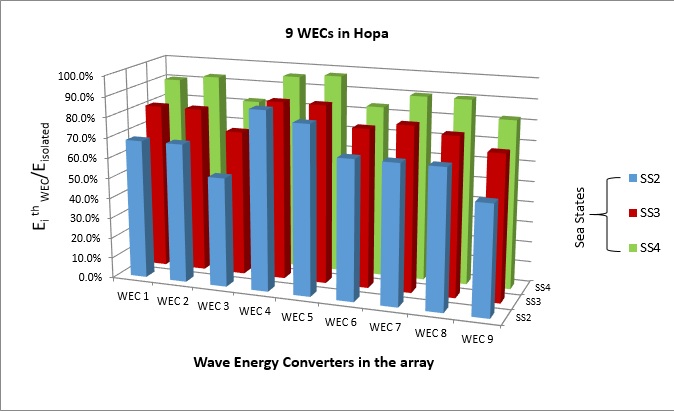
İlkay Özer Erselcan and Abdi Kükner from Istanbul Technical University investigated the effect of the number of wave energy converters in an array on the generation of energy. They analyzed one linear arrangement with two wave energy converters and two square arrays with 4 and 9 wave energy converters in four states experienced in two regions of the Eastern Black Sea coasts of Turkey by implementing a definite gap and wave direction. They also presented a detailed design of a hydraulic power take-off system. Their work is published in Ocean Engineering.
A float is the part of the wave energy converter that interacts with the waves, therefore providing the mechanical force as well as motion that the power take-off system needs in order to produce electricity. For this reason, it is important to know the motions of the float in a bid to compute the amount of electricity that can be produced in a selected sea state. Linear wave theory is majorly used in calculating the oscillatory motions experienced by ships and other sea-going vehicles due to the wave moments and forces acting on the bodies.
In the theory, the fluid is assumed inviscid, incompressible, and irrotational. Therefore, the fluid velocity is represented by the gradient of a scalar function, which is termed as the velocity potential. The wave amplitudes and motion amplitudes, which the body experience, are assumed smaller than the wave lengths and the corresponding body lengths.
The authors realized that the interaction of waves with the wave energy converters exhibit varying behaviors in the various array configurations and became even complicated as the arrays became larger. Their analyses carried out in three different arrays indicated that the hydrodynamic interaction of the waves with the floats led to a drop in the amount of energy produced by all the converters in the arrays. The authors did the analyses with a constant gap between the converters in all arrays and with one incident wave angle.
Erselcan and Kükner proposed that extent of the drop for energy produced as well as the severity of the hydrodynamic interaction of the waves with the bodies ought to be investigated. This should be done by defining different distances between the converters, different incident angles, and by analyzing arrays with varying configurations and with varying number of wave energy convers in the arrays.


Reference
İlkay Özer Erselcan and Abdi Kükner. A numerical analysis of several wave energy converter arrays deployed in the Black Sea. Ocean Engineering, volume 131 (2017), pages 68–79.
Go To Ocean Engineering