Advances in Engineering Advances in Engineering features breaking research judged by Advances in Engineering advisory team to be of key importance in the Engineering field. Papers are selected from over 10,000 published each week from most peer reviewed journals.

Significance
Organic light emitting diodes (OLEDs) are the technology of choice for future lighting and display applications. OLEDs can be fabricated into arbitrary shapes, made into flexible and wearable displays, and are more easily chemically tuned than semiconductor LEDs. The conventional design of OLEDs utilizes phosphorescent metal compounds such as platinum and iridium. These elements are becoming increasingly expensive and rare and cannot sustainably serve as the basis for humanity’s lighting needs. Moreover, their fabrication is conducted under high temperatures and ultralow pressures, drastically increasing the initial and operating costs for their production.
The development of purely organic thermally activated delayed fluorescent (TADF) materials has challenged this existing paradigm of OLED design. Organic molecules capable of TADF use spatially separated electron donors and acceptors to produce a high degree of mixing between singlet and triplet excited states – a necessary prerequisite for high efficiency OLEDs. Polymer-based OLEDs have the advantage of facile production methods with low operating costs for wide-area and high throughput manufacture.
There are two important considerations in the production of polymers for TADF OLEDs. First, the monomeric units must be specially tuned for their electron donating and accepting abilities. Second, the polymerization should not impede communication between electron donors and acceptors. Canadian researchers from the University of British Columbia: by Alexander Polgar and Professor Zachary Hudson proposed to use tailored monomers to generate TADF polymers that “inherit” the TADF property through polymerization. Their work was recently published in the journal Macromolecules.
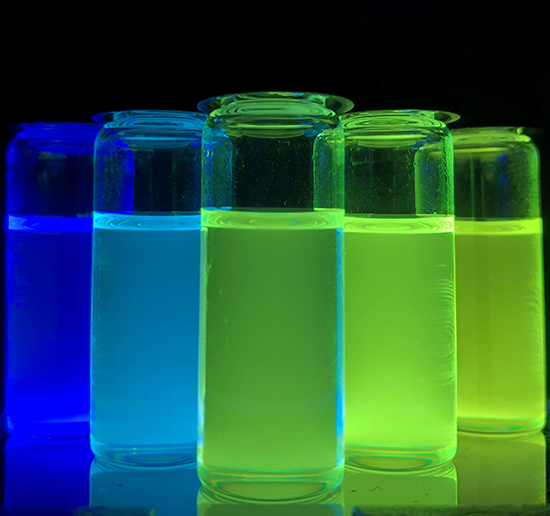
In their approach, a series of acrylic monomers exhibiting bright and tunable thermally activated delayed fluorescence was synthesized using pyrimidine acceptors and heterocyclic amine donors. The authors reported that Cu(0) reversible deactivation radical polymerization (RDRP) of the monomers yielded random copolymers with emission quantum yields near 100% in thin films. What is more, the method used simple copper wire – available from any hardware store – as the polymerization catalyst, with a low-cost room-temperature reaction setup.
This Canadian study demonstrated Cu(0)-RDRP as an effective method for preparing advanced TADF polymers at low cost and with minimal wasted material. This research is promising for the production of low-cost polymer LEDs, which may find their way into light-emitting textiles and consumer goods. The team aims to work with materials engineers moving forward to develop high-efficiency OLEDs without the need for expensive metal feedstocks.
Reference
Alexander M. Polgar, Jade Poisson, Nathan R. Paisley, Cheyenne J. Christopherson, Annelie C. Reyes, Zachary M. Hudson. Blue to Yellow Thermally Activated Delayed Fluorescence with Quantum Yields near Unity in Acrylic Polymers Based on D−π−A Pyrimidines. Macromolecules 2020, volume 53, page 2039−2050.