Advances in Engineering Advances in Engineering features breaking research judged by Advances in Engineering advisory team to be of key importance in the Engineering field. Papers are selected from over 10,000 published each week from most peer reviewed journals.

Significance
Ultrathin films are simply films grown using complex chemical and physically deposition techniques that are used in a variety of technologically advanced applications and measure less than 50 nanometers. To date, controlling electric dipoles in the ultrathin films has remained a key challenge due to the finite screening length of surface charges. This shortcoming can be attributed to the depolarization field, which tends to become more important as the ferroelectric film thickness is reduced. In a recent publication, a novel covalent-polar semiconductors have been reported by developing from a physical understanding of 3D hyperferroelectric. It shows an intrinsic 2D vertical polarization, consequently presenting new device opportunities. In fact, the aforementioned materials differ from ordinary ferroelectrics in that they are able to maintain polarization normal to a surface even with an unscreened depolarization field. Usually, these derivatives 2D material with broken mirror symmetry have attracted considerable attention consequent to their unique properties; namely, large piezoelectric effect, Rashba spin splitting, and second-harmonic generation response. Unfortunately, a fundamental challenge has plagued further development due to the fact that identifying stable phases that exhibit robust intrinsic 2D vertical polarization remains a challenge.
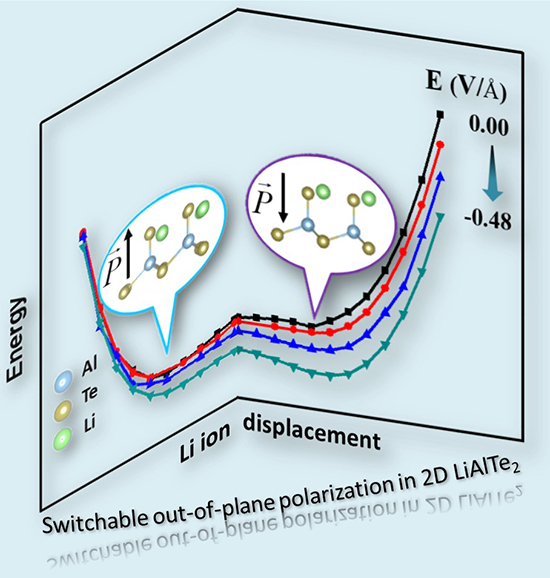
Therefore, there is a need to further develop the 2D material in order to unlock its full potential. In this context, Jilin University researchers: Dr. Zhun Liu and Professor Lijun Zhang (the leader of Theory & Design of Optoelectronic Semiconductors Group) together with Prof. David J. Singh at the University of Missouri proposed a systematic exploration of the 2D vertical polarization in a single LiAlTe2 atomic quadruple layer (QL) by studying the polar layers in the vdW type β-LiAlTe2. They aspired to develop a novel, yet auspicious phase via computational material design, using 2D LiAlTe2. Their work is currently published in the research journal, Advanced Electronic Materials.
The authors reported that in addition to the expected layered version of bulk LiAlTe2, β-LiAlTe2, a novel 2D structure, γ-LiAlTe2, was found. Furthermore, it was observed that in the reported phase, the vertical dipole could be switched between 0.07 and −0.11 e Å. Additionally, the associated asymmetric double-well energy profile could be continuously tuned by the applied electric field as well as strain.
In summary, the study explored the 2D vertical polarization in a single LiAlTe2 QL by studying the polar layers in the vdW type β-LiAlTe2. Results indicate that the global optimization structure search yields a nonpolar ground state and a series of 2D vertical polarization phases for a single LiAlTe2 QL. In a statement to Advances in Engineering, Professor Lijun Zhang highlighted that their discovered off-plane switch-ability provides an opportunity for a 2D γ-LiAlTe2 based interfacial phase-change memory device; for example, by growing γ-LiAlTe2/GeTe heterostructures.

Reference
Zhun Liu, Yuanhui Sun, David J. Singh, Lijun Zhang. Switchable Out-of-Plane Polarization in 2D LiAlTe2. Advanced Electronic Materials 2019, volume 5, 1900089.
Go To Advanced Electronic Materials