Advances in Engineering Advances in Engineering features breaking research judged by Advances in Engineering advisory team to be of key importance in the Engineering field. Papers are selected from over 10,000 published each week from most peer reviewed journals.

Significance
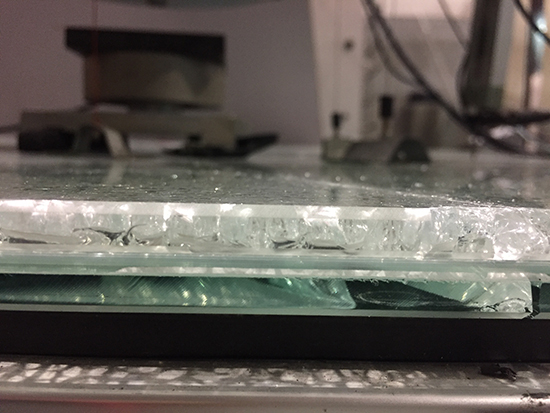
Glass has been used for decades to enhance the aesthetical appearance of buildings. In particular, laminated glass consisting of multiple glass sheets and polymeric layers is preferred over monolithic glass due to its good brittle properties. Just like other structural materials, they must, however, meet the safety requirements regarding the strength and ductility before and after breakage. To this end, post-breakage behaviors of broken laminated glass have been intensively explored. For instance, numerical and analytical models have been used to investigate crack propagation and failure behavior of various glass elements. However, these methods are not suitable for predicting the post-breakage behaviors of cracked laminated glass due to their strong discontinuity and nonlinearity. Consequently, depending on the kind of structural applications, the induced impact loads result in different cracked patterns that significantly affect the post-breakage performance of the laminated glasses.
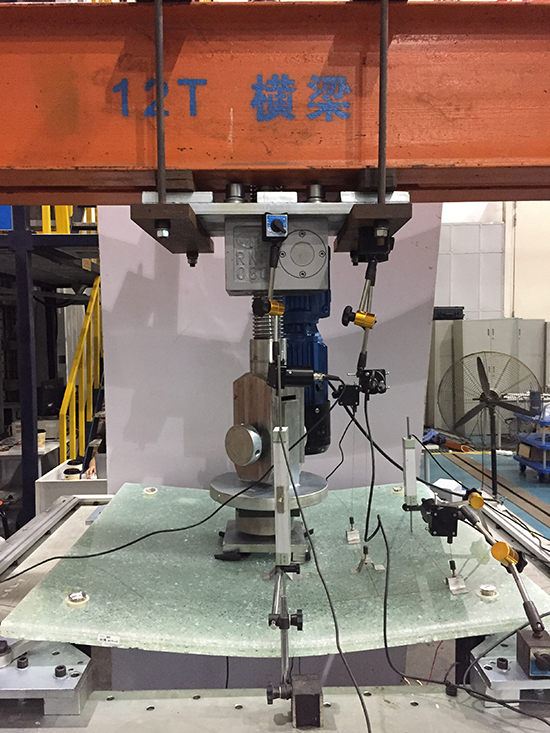
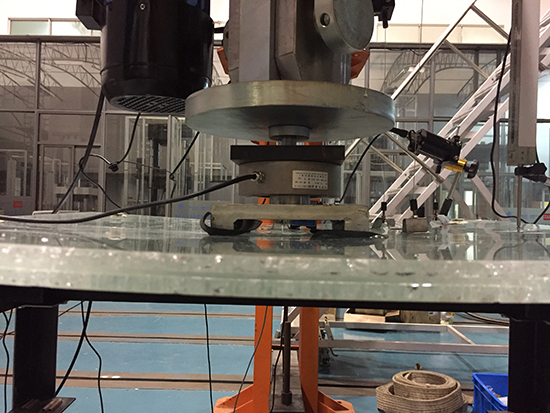
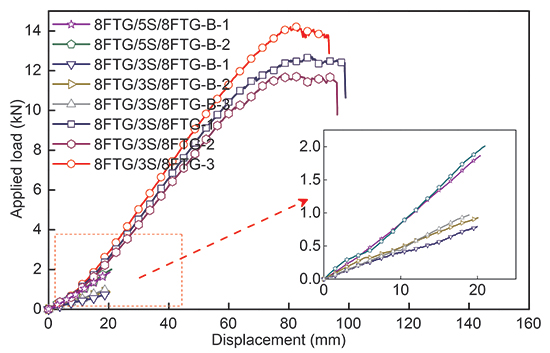
Recently, researchers at Shanghai Jiao Tong University: Chenjun Zhao (Ph.D. candidate), Dr. Xinger Wang (Postdoctoral fellow), Iftikhar Azim (Ph.D. candidate) and led by Professor Jian Yang examined the post-breakage behavior of cracked laminated glass plates. Their experiment was based on two support conditions: bolted and simple. A total of twenty-one specimens in groups of seven were tested under a constant loading speed of 45 mm.min-1. The work is currently published in the journal, Construction and Building Materials.
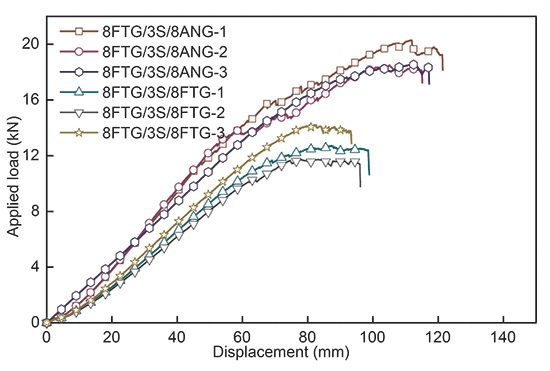
In brief, the research team started their experimental work by applying a weight-drop impact load to crack the glass plates of all the specimens to enable the creation of patterns. Next, the cracked glass plates were subject to continuous static load until collapse. Based on the applied loads and deflection at seven reference points on the specimen, the effects of the initial stiffness and post-breakage resistance on the post-breakage performance were investigated. Finally, the key parameters in both the pre- and post-breakage phases were compared to determine the post-breakage capacity ratio.
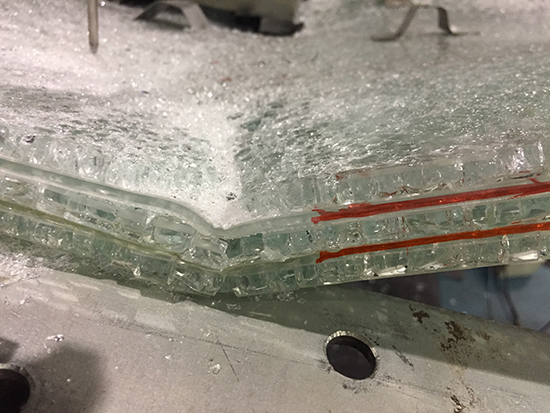
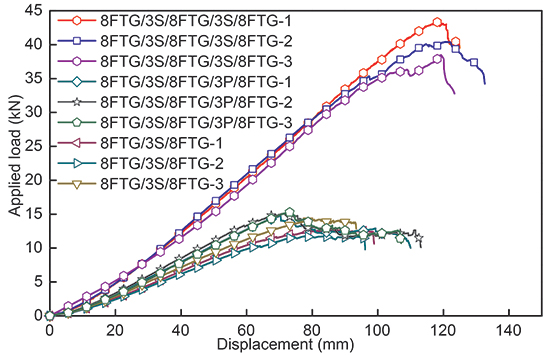
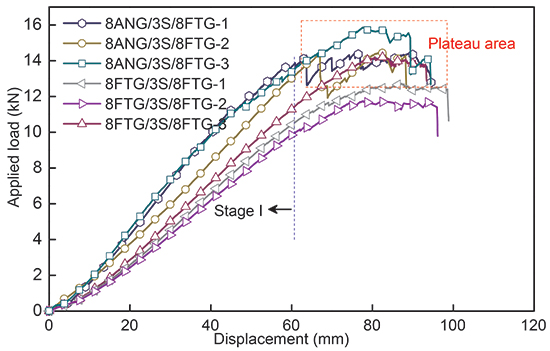
Results confirmed that the support conditions influence the yield line pattern and the post-breakage performance. The initial stiffness of the cracked laminated plate with simple support was approximately four times higher than that with bolted support. Whereas various crack patterns resulted in different crack offsets, these offsets depended on the fragment size and glass type. On the other hand, annealed glass sheets yield the highest initial stiffness and resistance in the post-breakage phase as compared to the fully tempered glass. This was attributed to its favorable crack pattern and tension stiffness effect that facilitate the resistance performance. Additionally, the ability of the laminated glass to penetrate before the complete formation of the yield lines was enhanced by increasing the number of the SentryGlas interlayers.
In summary, Shanghai Jiao Tong University scientists conducted thorough experimental studies to investigate the static characteristics of laminated plates cracked by impacts. Hybrid configurations reported a slight increase in the initial stiffness and peak resistance by allowing for more delamination at the plate edges without losing much load earing capacity. Considering that most of the stiffness is induced by the intact glass layer, post-breakage stiffness was observed to be negligible as compared to that for the pre-breakage phase. Altogether, their study provides essential information that will advance our knowledge on cracked laminated glass plates.




Reference
Zhao, C., Yang, J., Wang, X., & Azim, I. (2019). Experimental investigation into the post-breakage performance of pre-cracked laminated glass plates. Construction and Building Materials, 224, 996-1006.