Advances in Engineering Advances in Engineering features breaking research judged by Advances in Engineering advisory team to be of key importance in the Engineering field. Papers are selected from over 10,000 published each week from most peer reviewed journals.

Significance Statement
Oscillator instability is the main problem facing any type of system that receives or even transmits signals. In the modern technology, electronic oscillators produce clock signals with picosecond timing jitter. Using optoelectronic oscillators and cryogenic sapphire oscillator can help reduce this jitter level to a few femtoseconds. Alternatively, passively mode-locked lasers are desirable for ultralow jitter optical oscillator.
Passively mode-locked lasers produce uniformly spaced femtosecond laser pulses with excellent short term stability. The quantum-limited timing jitter is well below 1 fs. Phase locking to an optical/rf reference makes the mode-locked laser serve as an optical oscillator. Therefore, these ultralow jitter mode-locked lasers can be applied in a number of high precision applications, for instance, time-of-flight laser ranging, high spectral purify signal generation, coherent optical pulse synthesis, and large-scale time synchronization.
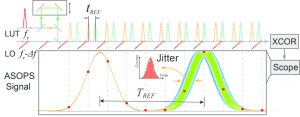
Researchers from Tianjin University in China demonstrated a time domain timing jitter characterization approach that is an optical equivalent to the eye diagram analysis at radio frequencies. The method implements an asynchronous optical sampling principle that is capable of stretching linearly ultra-fast processes such that sub-femtosecond period jitter of optical pulse train is visible to electronics with fast data acquisition capabilities. The authors implemented an asynchronous optical sampling by optical cross-correlating a pair of passively mode-locked Er—fiber lasers and a fixed offset repetition rate. Their work is now published in Optics Express.
The method adopted for the study was based on direct determination of sub-femtosecond precision pulse timing. The authors adopted two mode-locked lasers with repetition rates to serve as local oscillator and laser under test. The local oscillator as well as the laser under test operated with a close-to-zero cavity dispersion and were delivering, respectively, an output pulse duration of 440 and 905 fs.
The longer pulse duration from laser under test was attributed to an 8nm bandpass filter located just before the output. Limited bandwidth of the output was necessary for preventing aliasing in the following an asynchronous optical sampling stage. Intra-cavity filtering changed pulse metrics of the laser under use from a stretched pulse pattern to a dissipative soliton formation, hence bearing an increased timing jitter.
The experiment was performed first at a fixed offset repetition rate of 2kHz. In the microsecond acquisition time, the researchers observed that technical noise impact could be neglected, therefore, the mode-locked lasers were considered as quantum noise limited. They recorded and plotted standard deviation of visual timing jitter and acquired every data point from histogram analysis. They found out that constant visual timing jitter standard deviation of 0.35ns reflected electronic data acquisition system sensitivity, which was majorly determined by limited signal noise ratio.
When the rear pulse peak timing was fixed, the authors found that the timing jitter at 1.5kHz offset repetition rate was larger than that obtained at 2 kHz. That implied that low repetition rate was desirable for enhanced sensitivity of jitter measurement. Optical period jitter was the same at varying repetition rates. This was because a slight change in the repetition rate did not affect laser noise character.
The authors characterized femtosecond lasers quantum limited timing jitter implementing an asynchronous optical sampling principle. Therefore, atto-second sensitivity can be preserved with picosecond laser pulses.



Reference
Haosen Shi, Youjian Song, Jiahe Yu, Runmin Li, Minglie Hu, and Chingyue Wang. Quantum-limited timing jitter characterization of mode-locked lasers by asynchronous optical sampling. Optics Express 10, Volume 25, No. 1 | 9 Jan 2017 |
Ultrafast Laser Laboratory, Key Laboratory of Opto-electronic Information Technical Science of Ministry of Education, School of Precision Instrument and Opto-electronics Engineering, Tianjin University, Tianjin 300072, China.
Go To Optics Express