Advances in Engineering Advances in Engineering features breaking research judged by Advances in Engineering advisory team to be of key importance in the Engineering field. Papers are selected from over 10,000 published each week from most peer reviewed journals.

Significance
Bridges and other transportation structures are susceptible to failures that may lead to collapse and catastrophic accidents. To prevent such scenarios, there is a great need to obtain relevant information regarding the safety, durability, and functionality of the bridges. To this end, several bridges monitoring and intelligent control methods such as vibration-based damage identification technique have been developed. Unfortunately, most of these methods use the identified modal parameters to detect the structural damages which may not give the actual insight as it does not take into consideration the measurement noise. Additionally, they are based on the traditional acceleration and displacement responses with no consideration of the local responses. This makes identification of the local damages challenging.
Recently, strain-based methods have been identified to have potential solutions to the aforementioned challenges. This requires the use of sensors to detect the randomly occurring damages. Currently, Fiber Bragg Grating sensors are widely used in structural health monitoring owing to their excellent properties. Consequently, they can be used to achieve the distributed long-gauge strain sensing that is much sensitive to the local damage. The accuracy of the long-gauge strain sensors can be enhanced by appropriate selection of the gauge length. Considering the uneconomical nature of installing the health monitoring systems in short- and medium span bridges, development of rapid detection and monitoring methods in these cases is highly desirable. In a recently published literature, bridge condition assessment has been conducted based on the distributed macro-strain influence. However, the effects of vehicle parameters such as weight on the damage identification methods have not been fully explored. On the other hand, representing the damage extent of the bridge in a real bridge test is too challenging due to the unknown initial bridge condition.
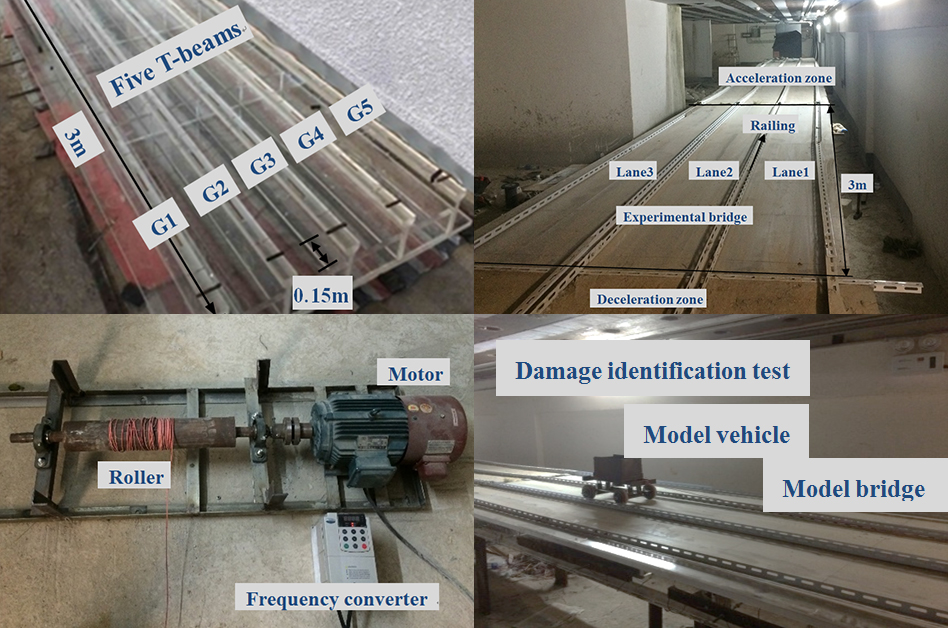
To this end, Dr. Bitao Wu at East China Jiao Tong University in collaboration with Professor Gang Wu and Professor Caiqian Yang from Southeast University investigated the highway bridge rapid assessment method based on the parametric variations of the vehicles. In particular, damages in the bridges structures under the moving loads were identified through a distributed macro-strain technique which comprised an integration of the long-gauge strain sensing technology and empirical mode decomposition method. Furthermore, a 1:10 scale model of the bridge-vehicle system was used in the experimental study where the long-gauge strain history was measured by long-gauge Fiber Bragg Grating sensor. The work is published in the journal, Mechanical Systems and Signal Processing.
The authors observed that the proposed parametric method accurately identified both the damage location and the damage extent since it was not affected by the vehicle parameters. However, a low accuracy for damage extents below 10% was noted. Additionally, higher damage extent identification accuracy was reported for both heavy and biaxial vehicles while triple-axial and light vehicles recorded low damage extent identification accuracy. Furthermore, the method was not affected by the ambient variation noises attributed to the high anti-noise performance of the optical signal. According to the authors, the method can be extended to post-bridge structural reinforcement design and capacity evaluation. Therefore, the study provides essential information that enables proper bridge assessment for damage detection thus preventing accident occurrence possibilities.





Reference
Wu, B., Wu, G., & Yang, C. (2019). Parametric study of a rapid bridge assessment method using distributed macro-strain influence envelope line. Mechanical Systems and Signal Processing, 120, 642-663.
Go To Mechanical Systems and Signal Processing