Advances in Engineering Advances in Engineering features breaking research judged by Advances in Engineering advisory team to be of key importance in the Engineering field. Papers are selected from over 10,000 published each week from most peer reviewed journals.

Significance Statement
Research team from Institute of Plasma Physics of the Czech Academy of Sciences developed procedure for formation of calcium titanate (CaTiO3) coatings or powders based on reactive suspension plasma spraying of mixture of powders CaCO3 and TiO2 dispersed in ethanol. Calcium titanate is widely used dielectric ceramics in electronic applications. Suspension plasma spraying procedure is promising for further technological use in coatings applications because for formation of dielectric CaTiO3 is not necessary to use calcium titanate but use of easily available precursors CaCO3 and TiO2 will satisfy.
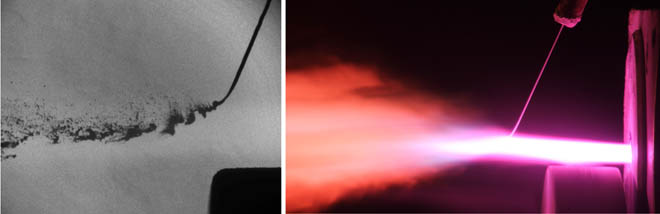
Figure Legend: Shadowgraphy of suspension penetration into plasma jet (left), suspension feeding into plasma jet (right).

Journal Reference
Ceramics International, Volume 42, Issue 3, 15 February 2016, Pages 4607–4615.
Jiri Kotlan1,2, Zdenek Pala1,Radek Musalek1,Pavel Ctibor1
[expand title=”Show Affiliations”]- Materials Engineering Department, Institute of Plasma Physics CAS, v. v. i., Za Slovankou 3, 182 00 Prague 8, Czech Republic
- Department of Electrotechnology, Faculty of Electrical Engineering, Czech Technical University in Prague, Technicka 2, 166 27 Prague 6, Czech Republic
Abstract
This study shows possibility of preparation of calcium titanate powder and coatings by reactive suspension plasma spraying. Suspension of mixture of calcium carbonate (CaCO3) and titanium dioxide (TiO2) powders in ethanol was fed into hybrid plasma torch with a DC-arc stabilized by a water–argon mixture (WSP®-H 500). Various feeding distances and angles were used in order to optimize suspension feeding conditions. In the next step, the coatings were deposited on stainless steel substrates and the effect of substrate temperature on microstructure and chemical and phase composition of the coatings was studied. Captured in-flight particles and deposits were analysed by X-ray diffraction (XRD) and scanning electron microscopy SEM equipped with EDX detector. Obtained results confirm that chemical reaction of CaCO3 and TiO2 forming CaTiO3 perovskite takes place during the interaction of suspension with plasma jet. The conditions of rapid cooling during spraying process result in the presence of metastable CaTiO3 high-temperature tetragonal and cubic phases. Increase in the substrate temperature increases the content of the calcium titanate in the deposit and the coatings microstructure becomes more compact. Obtained results show that WSP®-H technology may be used for deposition of the CaTiO3 powders and coatings by reactive plasma spraying.
Go To Ceramics International