Advances in Engineering Advances in Engineering features breaking research judged by Advances in Engineering advisory team to be of key importance in the Engineering field. Papers are selected from over 10,000 published each week from most peer reviewed journals.

Significance
Most ironworks operations involve the use of blast furnace. During the operation process, a lot of solid wastes products are produced. Such wastes, however, require efficient discharging systems which will also ensure their treatment so as to minimize their pollution effects on the environment. Blast furnace dust forms one of such solid wastes products. In most blast furnaces, the dust is discharged together with the blast furnace gas and thereafter removed through the off-gas treatment system. Blast furnace dust majorly consists of carbon and metal oxides such as iron oxides, calcium oxide, silicon oxide among others.
The high iron and carbon contents present in the discharged blast furnace dust has raised concerned about the possibility of an effective system for recycling and returning them to the sintering plants as raw materials. However, the blast furnace dust recycling process has been a difficult task to achieve due to the various factors involved. This includes low gas permeability and efficiency in the removal of zinc from the blast furnace dusts during the sintering process. As a result, several research works have been conducted with a bid to develop proper methods for blast furnace dust recycling.
A group of researchers at Northeastern University, School of Metallurgy in China led by Professor Nan Wang studied the reduction behavior of blast furnace dust particles during the in-flight process. This was in a bid to understand the reduction process, the role of the carbon particles contained, and factors affecting the reduction degree such as the composition of the reductive gas mixture and temperature. Their research work is published in the journal, Industrial and Energy Chemistry Research.
The authors commenced their study by investigating the effects of the microstructure of the dust particles and their morphology evolution during the in-flight process. The parameters and the rate controlling step of the process was determined through kinetic analysis.
The authors confirmed that the reduction degree of the process relied heavily on the gas composition and process temperature. For instance, the phase analysis showed that a temperature range of 1673-1723 K was required to form a reduced layer of the blast furnace dust particles in a molten state., representing an overall degree of 26.4-40.7%. Therefore, the in-flight process demands a high reduction temperature and greater carbon monoxide content to produce a high rate of blast furnace dust reduction.
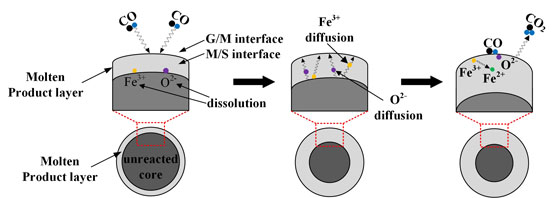
The success of Jin Xu and colleagues study is attributed to the fact that the rate controlling step of the gas-molten particles reduction during the process is as a result of the chemical reaction at the interface of the gas and molten product layer and a controlled ions diffusion through the molten product layer. This observation was based on the kinetic analysis of the reaction modulus and unreacted shrinking core model. However, the authors pointed out that chemical reaction controlling was good for the in-flight process only for reduction rates less than 10%. On the other hand, reduction rates exceeding 40% could be managed effectively by diffusion through the molten product layers.


Reference
Xu, J., Wang, N., Chen, M., Xin, J., Li, X., Li, H., & Wang, Y. (2017). Reduction Behavior of Blast Furnace Dust Particles during In-Flight Processes. Industrial & Engineering Chemistry Research, 57(1), 111-121.
Go To Industrial & Engineering Chemistry Research