Advances in Engineering Advances in Engineering features breaking research judged by Advances in Engineering advisory team to be of key importance in the Engineering field. Papers are selected from over 10,000 published each week from most peer reviewed journals.

Significance
The generation of physiologically relevant in-vitro models of biological barriers can play a vital role in understanding human diseases and in the development of more predictive methods for assessing toxicity and drug or nutrient absorption. Similarly, the ability to record cellular behaviors and functions with high spatial and temporal resolutions would enable fundamental comprehension of the underlaying bio-physics and cellular electrophysiology. In the past, this has been achieved through the application of various sensing platforms such as optical imagers, graphene-based sensors – among others. However, majority of these traditional approaches have limited spatial resolution owing to the fact their conceptual use was 2D based.
Recent publications have reported on the development of injectable/roll-able scaffold systems that enabled spatially resolved 3D mapping of cellular behaviors and functions in human-tissue mimicking environment. Unfortunately, shortfalls still remain for their long-term, high-fidelity recording due to the lack of effective means to electrically decouple all of the necessary electronic instrument settings from submerged conditions in a cell culture medium that in many cases demand additional packaging so as to prevent wetting and damaging.
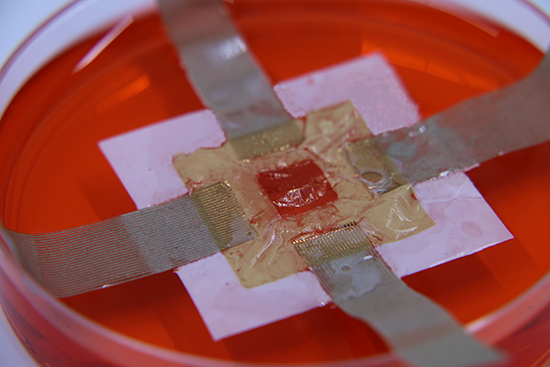
Therefore, the real-time monitoring of cellular behaviors and functions with sensor-instrumented scaffolds can in many ways provide a profound impact on fundamental studies of the underlying biophysics and disease modeling. In this view, a group of researchers from the Weldon School of Biomedical Engineering and School of Mechanical Engineering at Purdue University: Dr. Hyungjun Kim, Mr. Min Ku Kim, Mr. Bongjoong Kim, and Professor Chi Hwan Lee in collaboration with Dr. Hanmin Jang and Professor Dong Rip Kim from the School of Mechanical Engineering at Hanyang University developed an ultra-buoyant 3D instrumented scaffold that could remain afloat on the surface of culture medium and thereby provide favorable environments for the entire electronic components in the air while the cells reside and grow underneath. Their work is currently published in the research journal, ACS Nano.
Technically, the research team developed a 3D-stackable electronic scaffold (e-scaffold) integrated with an engineered ultra-buoy that allowed the entire structure to remain afloat on the surface of medium thereby offering favorable environments for both biological cells and electronics. Briefly, their approach entailed the fabrication of the e-Scaffold System where polyimide material was used. Next, the microporous sponge-like ultra-buoy system using a silicone elastomer (PDMS) were used. Generally, the approach ended with the measurement of impedance and ECG signal for a long period of time (weeks).
The authors reported that the physical stacking of the e-scaffold system enabled the incorporation of large numbers of addressable sensors in a multidirectional arrangement, offering the 3D mapping capability. Altogether, their findings suggested an expanded set of potential options such as long-term stable monitoring of tissue functions during/after in vivo transplant to replace diseased or damaged tissues.
In summary, the study demonstrated that the developed e-scaffold integrated system could allow for long-term, high-fidelity monitoring of cellular behaviors and functions in favorable environments for both biological cells and electronics. In an interview with Advances in Engineering, Professor Chi Hwan Lee emphasized that the presented setting could facilitate high-fidelity recording of electrical cell−substrate impedance and electrophysiological signals for a long period of time (weeks). Further, comprehensive in vitro studies revealed the utility of the presented platform as an effective tool for drug screening and tissue development.






Reference
Hyungjun Kim, Min Ku Kim, Hanmin Jang, Bongjoong Kim, Dong Rip Kim, Chi Hwan Lee. Sensor-Instrumented Scaffold Integrated with Microporous Sponge like Ultrabuoy for Long Term 3D Mapping of Cellular Behaviors and Functions. ACS Nano 2019, volume 13, page 7898−7904.
Go To ACS Nano