Advances in Engineering Advances in Engineering features breaking research judged by Advances in Engineering advisory team to be of key importance in the Engineering field. Papers are selected from over 10,000 published each week from most peer reviewed journals.

Significance
Rope plays a crucial role in water and fire rescue operations, serving as an essential tool for ensuring the safety of both rescuers and victims. In water rescue operations, such as swiftwater rescues or during floods, ropes provide a lifeline that rescuers can use to secure themselves and maintain stability. While in fire rescue operations for victims trapped in high-rise buildings or in situations where they need to be lowered or lifted to safety. Ropes also facilitate search and rescue operations by allowing firefighters to traverse hazardous terrain, descend into pits, or access hard-to-reach areas, ensuring the safety of both rescuers and victims. Advancements in rope materials and technologies have been continuously evolving in recent years. These advancements aim to enhance the strength, durability, and safety features of ropes used in rescue operations. Moreover, new developments have emerged that incorporate smart technologies into ropes used for rescue purposes rope incorporates sensors, monitoring systems, or communication capabilities. These features could provide real-time data and information to aid rescuers in assessing the safety and stability of the rope during operations.
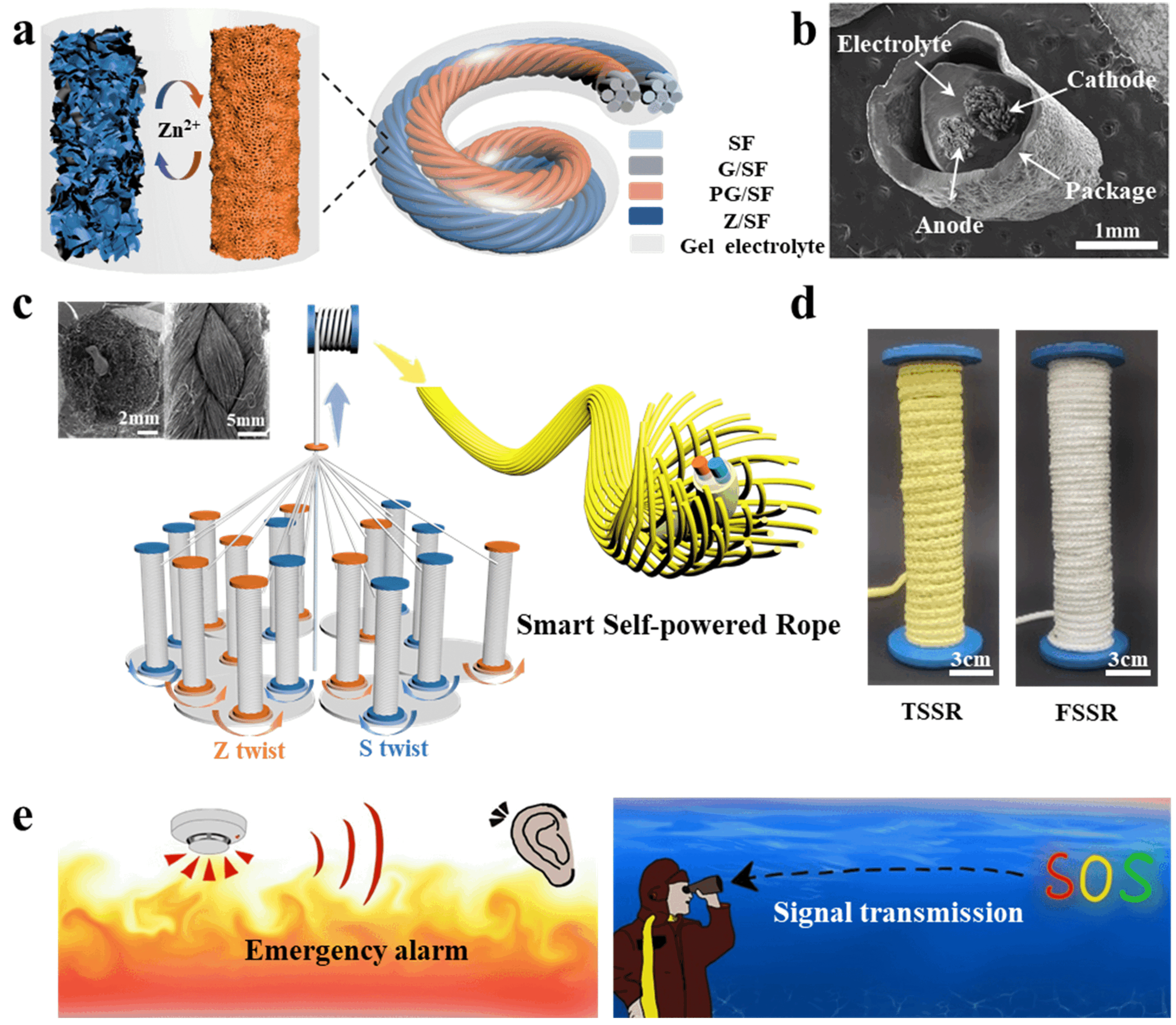
In a new study published in the peer-reviewed Journal Advanced Functional Materials, Professor Mingwei Tian and colleagues from the Qingdao University developed an innovative smart self-powered rope. The development of this new technology which they named the smart self-powered rope (SSR) has brought exciting possibilities for water and fire rescue applications. This innovative rope incorporates a construction strategy that integrates a fiber-based Zn battery (FZB) as a smart fiber unit, combined with traditional rope using braiding technology.
The research team showed that FZB used in the SSR demonstrates impressive characteristics, including a desirable specific capacity of 31.1 mAh cm−3, superior energy density of 33.5 mWh cm−3, and stable cycling stability of 81.95% even after 1000 cycles. This ensures reliable and long-lasting power supply for the smart rope. By employing flexible braiding technology, the authors designed the SSR to meet the specific requirements of water and fire rescue operations. It features a floatable and thermoduric SSR (FSSR and TSSR) that can withstand extreme environments and maintain their functionality. The core axial yarn of the SSR is composed of FZB, providing the necessary power source, while the shell braiding yarn incorporates ultra-high molecular weight polyethylene fiber (UHMWPEF) and aramid fiber.
According to the authors, the TSSR variant of the smart rope has proven particularly useful in fire rescue scenarios. It employs the interweaving of aramid fibers, which offer excellent fire resistance, acting as a protective outer layer for the energy device within the rope. As a proof of concept, a smart wearable fire alarm system has been integrated into the TSSR. This system monitors temperature variations and sounds an 84 dB alarm when detecting high temperatures, providing crucial warnings to firefighters in extreme fire environments. The system also allows for precise location tracking, aiding in the search and rescue of trapped individuals in fire cases.
Professor Mingwei Tian and co-workers extensively tested the TSSR’s electrochemical performance and thermostability, and demonstrated its exceptional fire resistance. While bare FZBs can be easily ignited, the TSSR remains functional even when exposed to flame for up to 20 minutes, thanks to the insulation layer provided by aramid fibers. The TSSR outperforms a SSR based on PET fiber, which is easily burnt out in flame. The consistent luminance values of LEDs powered by the TSSR, regardless of the presence of flame, further highlight its reliability and fire resistance.
In summary, the development of the smart self-powered rope reported in the study represents a significant advancement in water and fire rescue technology. Its successful integration of a fiber-shaped battery and traditional rope will open up possibilities for practical emergency rescue applications. The SSR’s impressive energy storage capabilities, fire resistance, and stable performance make it a valuable tool in shortening rescue times while maintaining its mechanical properties. It is hopeful this smart rope will achieve important role in rescue activities, ensuring the safety and efficiency of water and fire rescue operations.

Reference
Ming Li, Zengqing Li, Xiaorui Ye, Wenzhan He,* Lijun Qu,* and Mingwei Tian*. A Smart Self-Powered Rope for Water/Fire Rescue. Adv. Funct. Mater. 2023, 33, 2210111.