 Advances in Engineering Advances in Engineering features breaking research judged by Advances in Engineering advisory team to be of key importance in the Engineering field. Papers are selected from over 10,000 published each week from most peer reviewed journals.

Significance
The ever-increasing demand for energy in modern society has driven the exploration of alternative energy sources, including bio-oil derived from pyrolysis of high-polymer materials such as plastic and rubber tires. However, these resources often contain sulfur, which leads to undesirable sulfur oxide emissions during combustion. To mitigate environmental pollution caused by fuel combustion, countries worldwide have implemented strict standards to control sulfur content in fuels. Consequently, desulfurization has become an integral part of oil refining and upgrading processes to reduce environmental impact.
Various technologies, such as hydrodesulfurization (HDS), oxidation desulfurization (ODS), extraction desulfurization (EDS), adsorption desulfurization (ADS), and biological desulfurization (BDS), have been employed for desulfurization in the oil industry. HDS is a widely-used technology in oil refineries, but its high operating temperature and pressure lead to increased costs, especially for achieving deep desulfurization. Additionally, certain sulfur-containing compounds, particularly benzothiophene and dibenzothiophene derivatives, are challenging to remove through HDS due to their inertness and steric hindrance effects. In terms of operating circumstances, ODS is advantageous and effectively removes sulfides like benzothiophene and dibenzothiophene derivatives.
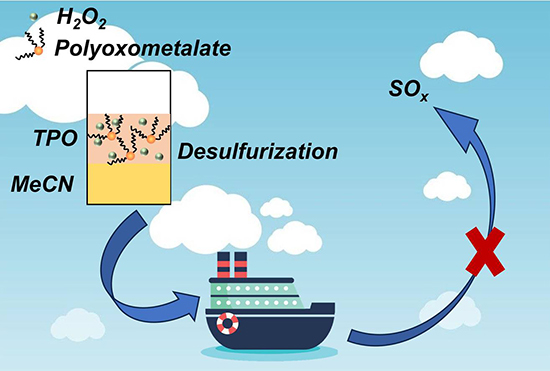
In recent research published in the peer-reviewed Journal of Cleaner Production, PhD candidate Yulin Zhang, and Fahim Ullah, led by Professor Aimin Li and associate Professor Guozhao Ji from Dalian University of Technology have explored the oxidation desulfurization process for the removal of sulfur compounds from tire pyrolysis oil (TPO) by ODS. The researchers employed a polyoxometalate (POM)-based catalyst, [C16H33N(CH3)3]3PW4O24, which showed remarkable catalytic performance for the oxidation of benzothiophene and dibenzothiophene derivatives present in the TPO. The authors demonstrated that this approach effectively reduced the sulfur content in the TPO, making it a promising solution for producing cleaner fuel alternatives.
In contrast to HDS, oxidation desulfurization (ODS) offers a more promising alternative for desulfurization. ODS operates at milder conditions, making it more energy-efficient and economically viable. The researchers highlighted the efficiency of ODS in converting heterocyclic sulfur compounds, such as dibenzothiophene derivatives, into corresponding sulfones using a phase transfer catalyst [C16H33N(CH3)3]3PW4O24 in the presence of hydrogen peroxide (H2O2) as the oxidant.
The [C16H33N(CH3)3]3PW4O24 catalyst plays a crucial role in the ODS process. The catalyst acts as a phase transfer agent, facilitating the transfer of reactive oxygen species from H2O2 to the sulfur compounds in the oil. This unique feature enhances the catalytic activity and makes the catalyst insoluble in both oil and water phases, providing an optimal environment for the ODS process.
The authors demonstrated that the [C16H33N(CH3)3]3PW4O24 catalyst exhibited impressive sulfide conversion efficiency of up to 99% for model oil. Importantly, the catalyst retained its efficiency even after repeated usage for ten cycles without any regeneration, indicating its stability and reusability.
Furthermore, the research team investigated the impact of distillation on improving desulfurization performance. By distilling the TPO, the researchers effectively reduced the presence of olefins in the oil, thereby enhancing the oxidation performance during the ODS process. They achieved a high desulfurization efficiency of 91.28% for the TPO190–350 ◦C fraction, significantly reducing the initial sulfur content.
In conclusion, Professor Aimin Li and associates provide a promising approach to achieving sustainable energy through oxidation desulfurization of tire pyrolysis oil. The use of the [C16H33N(CH3)3]3PW4O24 catalyst in conjunction with H2O2 as the oxidant demonstrated remarkable efficiency in converting sulfur compounds to sulfones, leading to effective desulfurization. The researchers’ focus on benzothiophene and dibenzothiophene derivatives, which are challenging to remove through traditional HDS methods, highlights the relevance of their findings in the context of global efforts to reduce environmental pollution caused by fuel combustion. Furthermore, the optimization of the TPO by distillation before desulfurization opens up new possibilities for producing cleaner fuel alternatives. As the demand for sustainable energy continues to rise, the insights provided by the new study hold promise for cleaner and more environmentally friendly energy sources derived from tire pyrolysis oil.


Reference
Yulin Zhang, Guozhao Ji, Fahim Ullah, Aimin Li. Polyoxometalate catalyzed oxidative desulfurization of diesel range distillates from waste tire pyrolysis oil. Journal of Cleaner Production 389 (2023) 136038
