Advances in Engineering Advances in Engineering features breaking research judged by Advances in Engineering advisory team to be of key importance in the Engineering field. Papers are selected from over 10,000 published each week from most peer reviewed journals.

Significance
Advancements in wireless communication technology have been relentless, with the pursuit of faster, more efficient systems driving researchers to explore new frontiers beyond 5G. One such frontier is Terahertz (THz) technology, which holds great promise for next-generation wireless communication systems. In a recent study published in the esteemed peer-reviewed Journal Optics Express, Professor Masahito Oh-e and Deng-Yun Zheng from the National Tsing Hua University in Taiwan have shed light on the significance of THz modulation technology and its potential applications in various domains. Terahertz frequencies lie between the microwave and infrared regions of the electromagnetic spectrum. Harnessing THz technology for wireless communication systems offers several advantages, including wider bandwidth and higher data transfer rates. However, the realization of these benefits relies heavily on further advances in THz modulation technology.
In this context, liquid crystals (LCs) have emerged as promising materials for controlling THz waves as quasi-optical components, such as phase shifters, gratings, polarizers, and filters. Liquid crystals exhibit refractive index anisotropy even in the THz band, making them suitable candidates for these applications. A significant advantage of LCs is their tunability, enabling them to be controlled using external fields at room temperature. This tunability allows for the development of dynamic devices capable of rapid adjustments in response to varying conditions.
However, a significant challenge arises when designing LC-based THz devices, specifically phase shifters. To achieve sufficient phase modulation at THz frequencies, these devices require a large cell gap of hundreds of micrometers or more. Consequently, this results in an unavoidable drawback—an extremely slow response due to the thick LC device. While external fields can facilitate relatively fast responses on the order of seconds or fractions of a second, switching without an external field can take tens or hundreds of seconds, severely limiting the practicality of such LC-based THz devices.
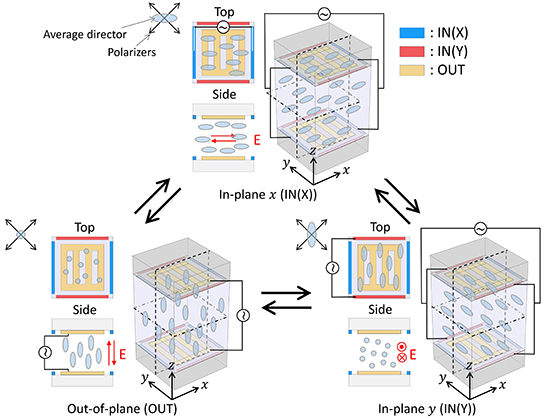
To address this limitation and improve the response times of LC-based THz phase shifters, researchers have been exploring different approaches. Professor Oh-e and Deng-Yun Zheng’s previous study revealed the dimensional effects of “THz in-plane and THz out-of-plane (TIP-TOP)” switching. In this approach, finger-type electrodes on a pair of parallel substrates create in-plane electric fields, while grating-type electrodes produce out-of-plane electric fields. Varying the dimensions of these electrodes was found to significantly influence the LC in-plane states and corresponding phase shifts. This discovery was pivotal in understanding the mechanism behind the dimensional effects and opened the door to novel LC switching methods, potentially enabling continuous reversible switching between three LC orientation states.
The proposed “three-state switching” presents a breakthrough in LC-based THz modulation technology. By employing a combination of in-plane and out-of-plane switching, researchers can achieve continuous reversible switching between three stable states—all governed by electric fields. The azimuthal and polar angles of 90° in three orthogonal orientation states in space play a crucial role in this switching scheme, offering a theoretically maximum range of continuous phase shifts of an LC.
While the potential of three-state switching is promising, further research is required to optimize its performance. Factors such as operating voltage and cell gap need careful consideration and systematic analysis to identify influential factors and mechanisms governing continuous reversible switching between the three LC orientation states. Researchers must devote their efforts to demonstrate the feasibility of this innovative switching scheme and translate it into real-world devices. The development of a prototype is currently underway, which will bring us one step closer to unlocking the full potential of THz technology in next-generation wireless communication systems.
In conclusion, the authors’ study sheds light on the importance of advancing THz modulation technology for next-generation wireless communication systems. Liquid crystals have emerged as promising materials for controlling THz waves, but their thick cell gaps have hindered fast response times. By introducing an innovative approach to LC-based THz modulation, the new study opens up new possibilities for various applications, including wireless communication, imaging, sensing, and spectroscopy. Faster and more efficient THz phase shifters will play a key role in making practical THz-based devices a reality. The proposed three-state switching offers a novel approach to achieve continuous reversible switching between three LC orientation states, potentially expanding the range of phase shifts with rapid responses. While further research and optimization are needed, the potential of this technology is undeniable. Indeed, the realization of practical devices based on this innovative concept could shape the future of wireless communication systems beyond 5G.

Reference
Oh-e M, Zheng D.-Y. Reversibly switching liquid crystals between three orthogonal orientation states for use in rapid-response THz phase shifters. Opt Express. 2023;31(5):8632-8640. doi: 10.1364/OE.484171.