 Advances in Engineering Advances in Engineering features breaking research judged by Advances in Engineering advisory team to be of key importance in the Engineering field. Papers are selected from over 10,000 published each week from most peer reviewed journals.

Significance
Cold regions in the world are divided into polar and sub-polar and are characterized by the presence of snow and ice at least part of the year. Residents of such areas are obliged to heat the living space. For instance, in china -where over 70% of the land lies in the cold region- inhabitants are subjected to heating time in excess of four months annually. Technically, such a population is predisposed to two heating methods: the central heating and the household heating. Over the years, researchers have developed modern heating systems that help circumvent the obvious disadvantages of traditional coal-powered heating techniques, i.e. low efficiency, high energy consumption and serious pollution. To this end, integrated heating system that utilizes renewable energy sources, such as: solar energy, bio-gas, geothermal and wind energy have been proposed. However, several shortfalls have been reported: such as, solar intermittency and instability for the case of solar energy, very low temperatures for biogas fermentations, etc. Therefore, in the wake of persistent campaigns to minimize consumption of fossil-based fuels, there is a growing concern among researchers on how best to heat up living spaces in such regions, where even the most abundant renewable resources seem scarce when most required.
Biomass energy is an effective supplement in low environment temperature, which has high energy density and stable energy output. With this in focus, a group of researchers from the College of Energy and Power Engineering at Lanzhou University of Technology : Professor Zhang Dong, Dr. Li Bingyang and Dr. Li Jinping, in collaboration with Dr. Zhao Qintong at the Key Laboratory of Complementary Energy System of Biomass and Solar Energy in China proposed a multiple renewable energy complementary heat pump system (MREHP). In the proposed MREHP system, the researchers aspired to use solar energy, biomass energy and air heat as the main heat source. Their work is currently published in the research journal, Solar Energy.
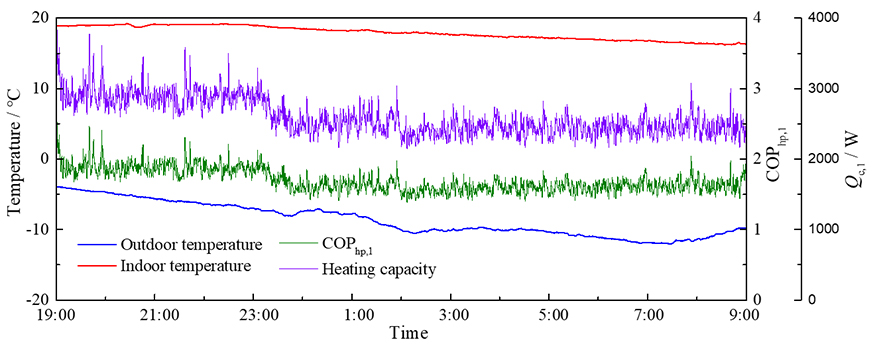
Technically, the proposed MREHP system was mainly composed of solar collector unit, constant temperature biogas pool unit and heat pump unit. The team adopted three modes for the system: i.e. air source (Mode 1), solar-air energy (Mode 2) and solar-biomass-air energy (Mode 3). The researchers carried out experimental studies where the average outdoor and indoor temperatures in three modes were −8.64 °C, −12.43 °C, -11.18 °C and 17.91 °C, 21.31 °C, 20.17 °C, respectively. Also, the averages coefficient of performances (COP) of the heat pump were 1.70, 2.32 and 2.26, respectively.
The authors reported that, in Mode 1, air heat input accounted for 41.09%. The proportion of air heat input in Mode 2 was seen to greatly reduce, while as the solar energy input system accounted for 40.32%. Further, the researchers reported that in Mode 3, the energy input of air heat, solar energy and biomass energy were basically equal. Overall, the utilization of renewable energy in the three modes of proposed system accounted for 41.09%, 57.34% and 55.67%, respectively.
In summary, the study presented a heat pump system based on multiple renewable energies as auxiliary heat sources. The proposed system utilized air, solar and biomass energy as auxiliary energy for heat pump systems. The researchers established that renewable energy utilization in Mode 2 and Mode 3 exceeded 50%. Remarkably, the system could meet the indoor space heating demands under different conditions. In a statement to Advances in Engineering, Professor Zhang Dong highlighted that the system reduced the consumption of electricity by utilizing renewable energy.







Reference
Zhang Dong, Li Bingyang, Zhao Qintong, Li Jinping. Thermal performance and energy characteristic analysis of multiple renewable energy complementary heat pump system. Solar Energy, volume 196 (2020) page 287–294.