Advances in Engineering Advances in Engineering features breaking research judged by Advances in Engineering advisory team to be of key importance in the Engineering field. Papers are selected from over 10,000 published each week from most peer reviewed journals.

Significance Statement
It has been observed that polymers as well as nanocomposites with presence of carbon nanotubes exhibit coupled thermo-mechanical properties which can be used for energy dissipation and damping undesired vibrations.
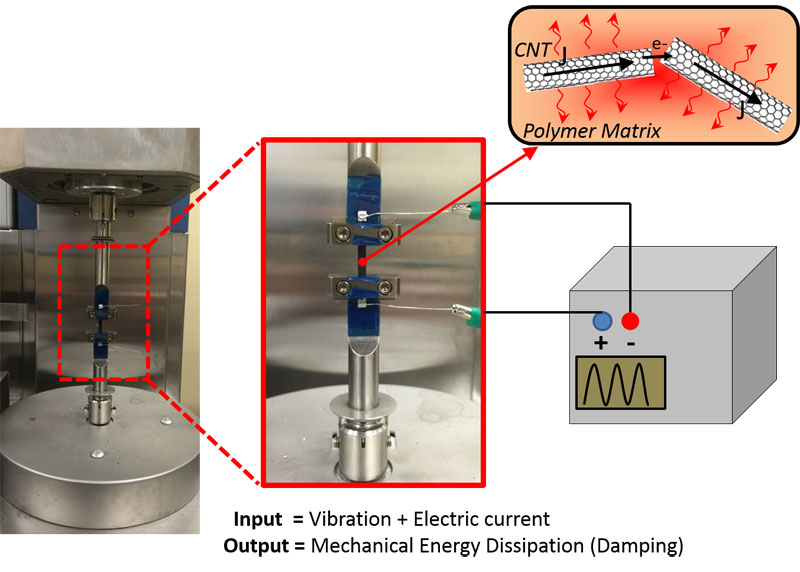
A new study on the active damping of polymer-based nanocomposites with carbon nanotube reinforcement was reported in the journal, Composites Science and Technology. Researchers led by Dr. Mohammad Naraghi from Texas A&M University in collaboration with scientists from Vehicle Technology Directorate at the US Army Research Laboratory, controlled the damping of the composites with the aid of Joule heating.
The authors fabricated a nanocomposite with a semi-crystalline polymer matrix, poly ether ether ketone (PEEK) which was reinforced with carbon nanotubes to demonstrate active damping during Joule heating.
The effect of temperature gradient which may lead to non-uniform temperature distribution during Joule heating was analyzed both in macroscale and microscale temperature level. At the macroscale level, analytical models and finite element analysis were conducted while at the microscale level, temperature gradient around the carbon nanotubes, involved analytical modeling.
Studies performed using differential scanning calorimetry indicated a lowered degree of crystallization for PEEK when carbon nanotubes were added. The increase in glass transition temperature for PEEK samples as annealing time increases was also found to be lower when carbon nanotubes were added. The presence of carbon nanotubes decreased the storage modulus value due to CNT agglomeration.
While studying the active damping characteristics of the polymers with the use of Joule heating, they found that an increase in power output led to the instigation of polymer chain relaxation and viscous mechanism in the composites of PEEK with reinforced carbon nanotubes. A highly advantageous improvement in damping coefficient, by as much as 400% was attained at a loss of 42% in storage modulus. Also, the figure of merit with an increased input power also had a 150% improvement.
Despite the occurrence of non-uniformity in temperature, PEEK samples were capable of limiting the loss in the storage modulus even at larger temperature distribution. No effects of thermal degradation occurred in the polymers as the reversible active damping and stiffness was noticed before and after Joule heating.
Temperature non-uniformity at the microscale was attributed to the agglomeration of carbon nanotubes as a result of increases in effective diameter. Carbon nanotube agglomerates led to an excessive variation of temperature changes between 10 and 50°C. An improved dispersion of carbon nanotubes may additionally generate better temperature uniformity. Temperature non-uniformity may lead to a loss in both loss and storage modulus, and as such is highly undesired.
“The temperature non-uniformity, especially in the macroscale, is a direct consequence of convective heat loss on the surface of the sample. As such, the active damping can be highly beneficial and efficient in applications where convective heat loss is suppressed, such as application in space and for deployable structures, in which the elastic energy stored in the material is what guides the deployment, while the release of the elastic energy in short periods of times without much inherent damping, may damage the structures,” said Naraghi.
This study was able to highlight the importance of dispersing uniform carbon nanotubes in order to limit the non-uniform temperature distribution which may affect the desired damping efficiency.


Journal Reference
F. Gardea1, B. Glaz2, J. Riddick2, D.C. Lagoudas1, M. Naraghi1, Thermally Activated Energy Dissipation in Semi-Crystalline Polymer Nanocomposites, Composites Science and Technology 134 (2016) 275-286.
[expand title=”Show Affiliations”]- Department of Aerospace Engineering, Texas A&M University, 3409 TAMU, College Station, TX 77843-3409, USA
- Vehicle Technology Directorate, US Army Research Laboratory, Aberdeen Proving Ground, MD 21005-5066, USA
Go To Composites Science and Technology