Advances in Engineering Advances in Engineering features breaking research judged by Advances in Engineering advisory team to be of key importance in the Engineering field. Papers are selected from over 10,000 published each week from most peer reviewed journals.

A novel mesoscale model considering meso-structural characteristic of aggregate
Significance
Concrete is widely used in the building and construction industry owing to its excellent properties. With advancements in technology and rapid economic and infrastructural development, future structural engineering technology must be tailored to meet the increasing size and performance requirements. This includes conducting thorough studies on the mechanical behaviors of concrete materials. For the past decades, compression test has been widely employed to understand the compressive behaviors of concrete materials under different conditions. In particular, the size effect of the materials and concrete components, which is crucial in constructing large-size concrete structures, is of great importance. Based on the previous research works, uniaxial compressive behaviors of concrete have been greatly associated with height-to-diameter ratios in which the stress-strain curve is size-dependent when the length-to-diameter ratio exceeds a critical point. These revelations opened the way for expansive studies on the compressive behavior of different types of concrete materials.
Coral aggregate concrete (CAC), composed of coral aggregates, cement, seawater, and other admixtures, has been identified as a potential replacement for ordinary concrete. It has been increasingly applied in reef constructions, especially in the United States. Nevertheless, its performance has generally remained lower than that of ordinary concrete, thus limiting its applications. One way of improving the performance and applications of CAC is by understanding its compressive behaviors with different aspect ratios, which requires computer-based numerical simulations such as the mesoscale modeling approach due to the limitations of the laboratory experiments. However, the drawbacks of the mesoscale modeling approach, such as the random characteristic of the aggregate particle, can be overcome by coupling it with a three-dimensional (3D) random particle model that has proved to be highly effective.
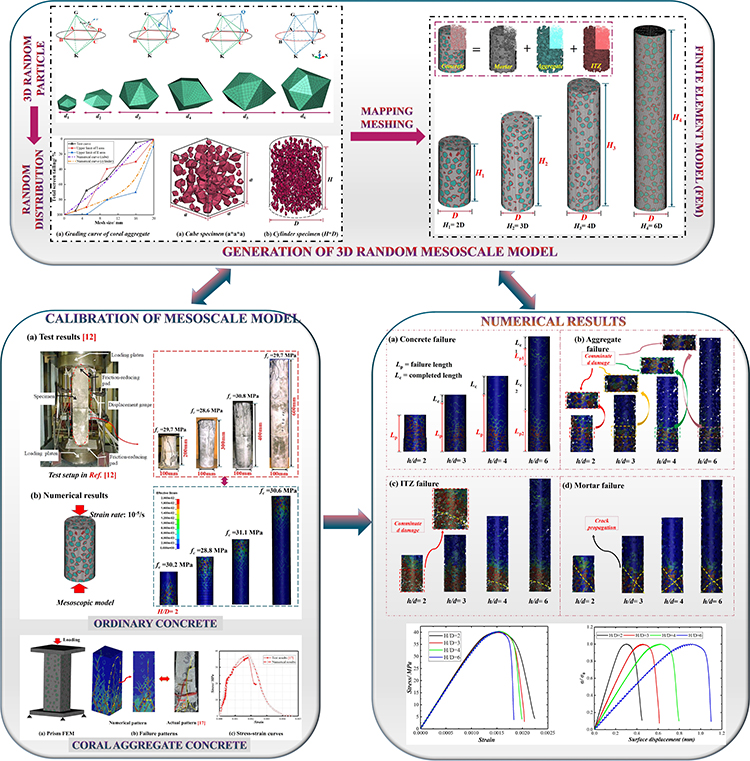
In a recent paper published in the Composites Part B journal, a team of researchers at Nanjing University of Aeronautics and Astronautics: Mr. Zhangyu Wu, Prof. Hongfa Yu, and Dr. Haiyan Ma, in collaboration with Prof. Jinhua Zhang from Southeast University, investigated the effects of specimen aspect-ratio (height-to-diameter ratio) on the compressive behavior of CAC based on a 3D mesoscale modeling approach. They aimed to validate the feasibility of using 3D random mesoscale modeling in studying the uniaxial compressive behaviors of CAC with different aspect ratios.
In their approach, the researchers developed a novel 3D mesoscale modeling approach taking into account the random shapes and distributions of coarse aggregates in concrete. CAC cylinder specimen with different aspect ratios (2-6) were investigated to obtain the aspect-ratio effect law on their uniaxial compressive strength. Also, failure patterns, stress-strain relations, and failure processes of CAC were analyzed under compression. Finally, the numerical results were compared to the existing test results to validate the effectiveness of the presented mesoscale modelling approach.
Results showed that the peak displacements of the CAC were proportional to the specimen length. As such, the post-peak stress-strain curves became steeper with an increase in the specimen length, attributed to the localization behavior of the concrete. Consequently, the failure zone length of the CAC specimen was observed to be close to three times (270 – 300mm) larger than that of the specimen diameter (100mm) when the height-to-ratio diameter exceeded 2-3. The results were in good agreement with those of the ordinary concrete. Furthermore, distinctive failure characteristics of CAC cylinders with different aspect ratios revealed a faster failure process in shorter specimens. For longer specimens, however, it showed that the cracks could obliquely propagate in the lateral surface.
In summary, the authors reported the application of 3D mesoscale modeling approach to study the specimen aspect-ratio effect on the compressive behavior of CAC. Based on the simulation results, the rationality of the presented approach and selected material parameters were successfully validated under different conditions. The authors found out that the uniaxial compressive strength of CAC is greatly affected by its aspect ratio, but the strength differences decrease significantly when the aspect ratio exceeds 2.5 – 3. In a statement to Advances in Engineering, said their study advances the development of high-performance CAC materials for numerous construction applications.




Reference
Wu, Z., Zhang, J., Yu, H., & Ma, H. (2020). 3D mesoscopic investigation of the specimen aspect-ratio effect on the compressive behavior of coral aggregate concrete. Composites Part B: Engineering, 198, 108025.