Advances in Engineering Advances in Engineering features breaking research judged by Advances in Engineering advisory team to be of key importance in the Engineering field. Papers are selected from over 10,000 published each week from most peer reviewed journals.

Significance
Information and communication technologies play more and more critical roles in the modern exploration of the ocean, leading to deep understanding of creature evolution, natural resource development, and national security. Underwater communication helps to collect and exchange information among autonomous underwater vehicles (AUVs), submarines, ships on the water surface, divers, people on board, location tracking of underwater athletes, and so on.
Underwater optical wireless communication (UOWC) technology offers advantages over long-wave radio frequency and underwater acoustic communications in high data rate, low latency, and high security. However, extending its communication distance and increasing data rate have been hindered by strong water absorption, scattering and turbulence.
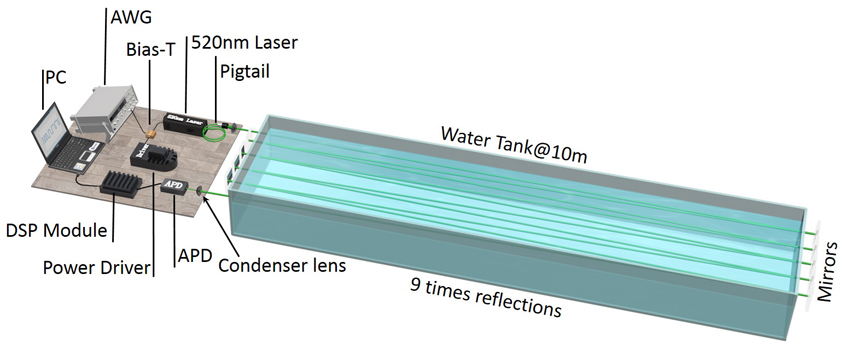
Recently, Jiemei Wang, Chunhui Lu, Dr. Shangbin Li, and Professor Zhengyuan Xu at University of Science and Technology of China (USTC) proposed an effective experimental approach to counteract the water distortion by a novel experimental design and advanced signal processing techniques. They demonstrated an experimental long-distance high-speed UOWC system, achieving 100m/500Mbps based on a 10m-long water tank. The water quality in their experimental system was comparable to that of pure seawater in terms of their measured extinction coefficient and thus might simulate a deep-ocean communication environment. They also predicted a communication performance of 146m/500Mbps and 174m/100Mbps through the same water. This performance has achieved a great breakthrough and significantly advanced the state-of-art in range-rate performance of underwater communication.




Reference
Jiemei Wang, Chunhui Lu, Shangbin Li, Zhengyuan Xu. 100 m/500 Mbps underwater optical wireless communication using an NRZ-OOK modulated 520 nm laser diode. Optics Express, volume 27, no. 9 (2019) page 12171-12181.
Go To Optics Express