 Advances in Engineering Advances in Engineering features breaking research judged by Advances in Engineering advisory team to be of key importance in the Engineering field. Papers are selected from over 10,000 published each week from most peer reviewed journals.

Significance
The heat transfer intensity is a critical aspect of cooling systems. And to maintain the desired preservation conditions and integrity of the system requires the removal of the heat fluxes. Recently, modified surfaces have emerged as a promising approach for intensifying the heat transfer and increasing the critical heat fluxes (CHF). To date, numerous techniques for fabricating these modified porous surfaces have been proposed. In particular, a number of the reported studies focus on using three-dimensional (3-D) printing (selective laser melting / sintering (SLM / SLS) techniques) to develop efficient heat transfer systems. SLM / SLS methods allow the production of complex geometries, which eliminates the need for further processing.
Even though SLM/SLS techniques have been successfully used to produce different heat exchange units made of different materials, they have been sparsely applied to produce structured surfaces. Additionally, there are no reports on heat transfer enhancement on liquid boiling in subcooling and saturated conditions on the few structured surfaces constructed by SLM/SLS techniques. Therefore, structured coatings with controlled parameters are necessary to better understand their characteristics and influencing mechanisms on heat transfer and CHF during evaporation and boiling conditions.
Pressure is an independent parameter that significantly affects the heat transfer during boiling. Despite the good research progress, the heat transfer in varying liquid heights and at different pressures is rarely studied. To bridge the existing research gap, Professor Vladimir Zhukov from Novosibirsk State Technical University, Professor Aleksandr Pavlenko and Ph.D. student D.A. Shvetsov from Kutateladze Institute of Thermophysics SB RAS in Russia investigated heat transfer under evaporation and boiling conditions in thin horizontal layers. In particular, the effects of relative pressure and the height of the liquid layers on the heat transfer during boiling and evaporation on the microstructured surface with 2D modulated capillary porous coating was investigated. The original research article is now published in the International Journal of Heat and Mass Transfer.
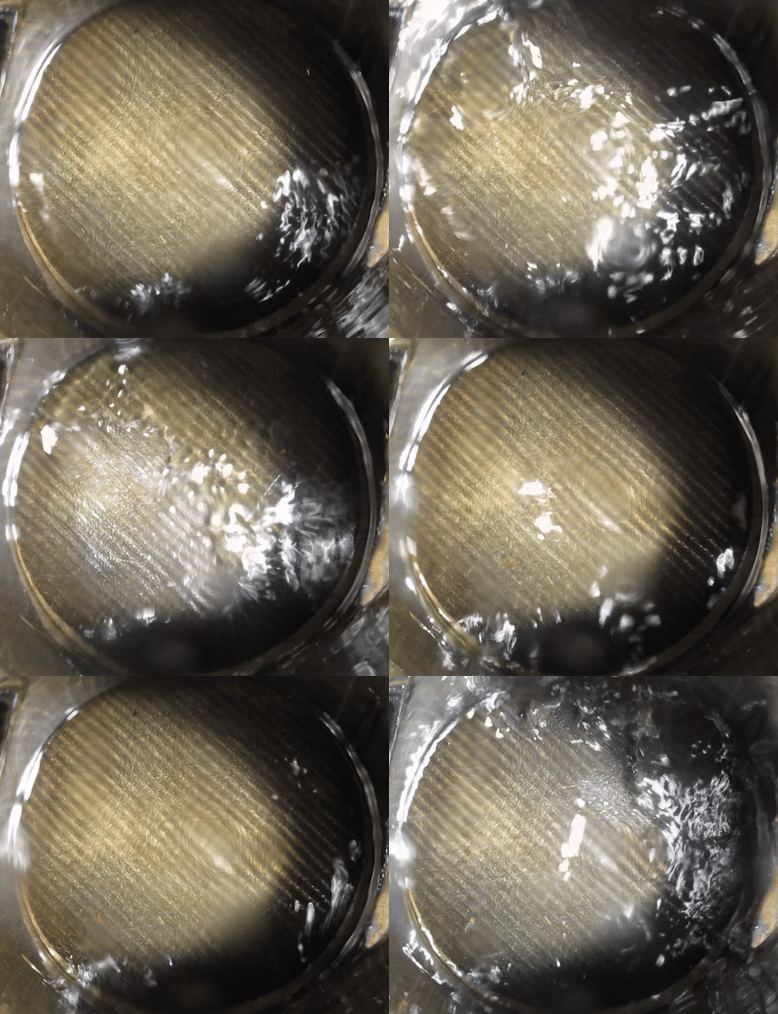
In brief, the capillary-porous coating with a sinusoidal 2D modulated profile was obtained via 3D printing of selective laser sintering. And the same coating was used for the entire experiment. The height and pressure of the liquid layer varied over a wide range. The variation in the heat transfer coefficient with changes in the relative pressure and height of the liquid layers was studied in detail. Finally, the experimental results were compared with those obtained from boiling and evaporation under the same conditions on a smooth surface.
The authors observed an increase in the heat transfer coefficient with an increase in the relative pressure in the boiling regime. Compared to the capillary-porous surfaces, the smooth surface produced a high heat transfer coefficient during evaporation at low pressures. On the other hand, the coefficient on the capillary-porous coatings was significantly (more than three times) greater than that reported for smooth surfaces during boiling at moderate relative pressures. Furthermore, the CHF on the capillary-porous coating increased with an increase in the height of the liquid layers.
In summary, different heat transfer modes during boiling and evaporation on a porous coating in thin liquid layers under different pressures were investigated. The effects of the relative pressure and liquid height on the heat coefficient on the porous coating were critically discussed at boiling and evaporation regimes. A significant increase in the CHF on the surface of the porous coating was reported at a layer height greater than 4mm. In a statement to Advances in Engineering, Professor Aleksandr Pavlenko said the study pave way for future heat transfer studies on different microstructured surfaces.



Reference
Zhukov, V., Pavlenko, A., & Shvetsov, D. (2020). The effect of pressure on heat transfer at evaporation/boiling in horizontal liquid layers of various heights on a microstructured surface produced by 3D laser printing. International Journal of Heat and Mass Transfer, 163, 120488.