Advances in Engineering Advances in Engineering features breaking research judged by Advances in Engineering advisory team to be of key importance in the Engineering field. Papers are selected from over 10,000 published each week from most peer reviewed journals.

Significance Statement
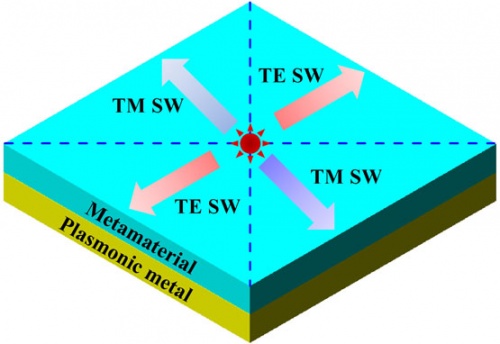
Surface waves (SWs) are eigen electromagnetic (EM) surface modes bounded on dielectric/metal interfaces, which exhibit many fascinating properties (e.g., subwavelength resolution and dramatic local-field enhancement) and thus have numerous applications in practice. However, Surface waves supported by a conventional plasmonic metal suffer many restrictions (say, they can have transverse-magnetic (TM) polarizations). Here, we show that putting an ultra-thin anisotropic metamaterial layer on a plasmonic surface significantly enriches the Surface wave characteristics of the system, which now supports Surface waves with both TM and transverse-electric (TE) polarizations simultaneously. In addition, the generated Surface waves exhibit hybridized polarization characteristics in certain cases, and a Surface waves band gap opens within a particular propagation direction range. We designed and fabricated a realistic structure based on the proposed model, and combined microwave experiments with full-wave simulations to verify the fascinating theoretical predictions. Our findings can have potential applications in practice (e.g., building planar subwavelength EM devices/circuits for signal transport, etc. ).
Journal Reference
Opt Express. 2013;21(15):18178-87.
Song Z, Li X, Hao J, Xiao S, Qiu M, He Q, Ma S, Zhou L.
State Key Laboratory of Surface Physics and Physics Department, Fudan University, Shanghai 200433, China.
Abstract
We show that putting an ultra-thin anisotropic metamaterial layer on a plasmonic surface significantly enriches the surface wave (SW) characteristics of the system, which now supports SWs with transverse-magnetic (TM) and transverse-electric (TE) polarizations simultaneously. In addition, the generated Surface wave exhibit hybridized polarization characteristics in certain cases, and a Surface wave band gap opens within a particular propagation direction range. We designed and fabricated a realistic structure based on the proposed model, and combined microwave experiments with full-wave simulations to verify the fascinating theoretical predictions. Several potential applications of the proposed system are discussed in the end.