Advances in Engineering Advances in Engineering features breaking research judged by Advances in Engineering advisory team to be of key importance in the Engineering field. Papers are selected from over 10,000 published each week from most peer reviewed journals.

Significance Statement
The innovative character of the work that we have developed so far is to focus adaptive optics (AO) developments for Fluorescence Correlation Spectroscopy (FCS) and related techniques (Raster/scanning Image Correlation Spectroscopy, etc.). FCS, in its simplest form, consists in analyzing the temporal trace of the fluorescent signal of a confocal microscope, at a single point of the sample, to estimate the average number of molecules in the observation volume and the diffusion time. Optical aberrations decrease the signal to noise of FCS experiment, but also biases measurements: for example, in the case of free-diffusion, it sounds like fluorescent molecules would be slower and more numerous in the presence of aberrations, simply because the observation volume is larger. AO correction for FCS allows to sharply refocus the probing beam and makes comparative analysis within an inhomogeneous sample possible.
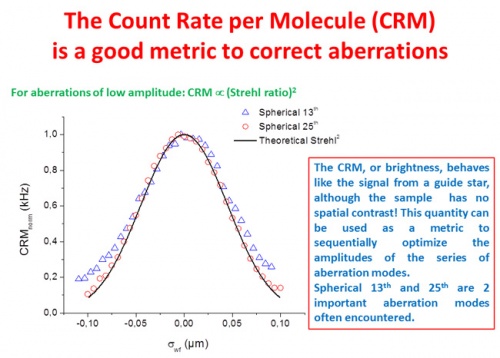
The weakening of the detection efficiency and the widening of the observation volume can be combined in a single parameter called the count rate per molecule or brightness. Interestingly enough, the brightness behaves, versus the aberrations, like the signal than would obtain from a single, isolated guide star (see figure), which is known as the Strehl ratio. This is surprising, as the brightness is measured in regions of interest where molecules are freely diffusing, that is where images do not exhibit any localized bright spots or any well-defined structures. In other words, our approach is efficient in situations where image-based metric would fail.
Besides imaging, microscopy is currently developed towards quantitative measurements, especially those devoted to measure concentration, mobility and interactions of molecules in living cells, which are central issues in modern biology and biotechnologies. FCS and the related technics are thus of primary importance, but are, unfortunately, highly sensitive to aberrations. The technique we have developed is thus very desirable because it makes these methods more quantitative and robust.
Journal Reference
Optics Letters, Vol. 38, Issue 14, pp. 2401-2403 (2013).
Charles-Edouard Leroux, Alexei Grichine, Irène Wang, and Antoine Delon.
University of Grenoble 1/CNRS, LIPhy UMR 5588, Grenoble 38402, France and
University of Grenoble 1/INSERM, Institut Albert Bonniot, CRI U823, Grenoble 38706, France
Abstract
We describe the effect of optical aberrations on fluorescence fluctuations microscopy (FFM), when focusing through a single living cell. fluorescence fluctuations microscopy measurements are performed in an aqueous fluorescent solution and prove to be a highly sensitive tool to assess the optical aberrations introduced by the cell. We demonstrate an adaptive optics (AO) system to remove the aberration-related bias in the fluorescence fluctuations microscopy measurements. Our data show that AO is not only useful when imaging deep in tissues but also when performing fluorescence fluctuations microscopy measurements through a single cellular layer. This work paves the way for the application of fluorescence fluctuations microscopy to complex three-dimensional multicellular samples.
© 2013 Optical Society of America