Advances in Engineering Advances in Engineering features breaking research judged by Advances in Engineering advisory team to be of key importance in the Engineering field. Papers are selected from over 10,000 published each week from most peer reviewed journals.

Significance Statement
In non-linear fracture mechanics, the J-integral approach has been most widely used for the characterization of the fracture resistance of materials. However, fundamental conceptual difficulties existed when applying the J-integral to elastic-plastic materials, especially in case of crack extension during monotonic loading, or for cracks in cyclically loaded components.The new J-integral for incremental theory of plasticity (Simha et al., 2008) overcomes these difficulties. It is demonstrated in the current paper that should be calculated for a contour around the active plastic zone, in order to quantify correctly the crack driving force for a stationary or growing crack under monotonic loading. Ochensberger and Kolednik (2014) show that thesame applies for a cyclically loaded crack.The magnitude of the crack driving force determines whether a crack in a structure can grow or not.
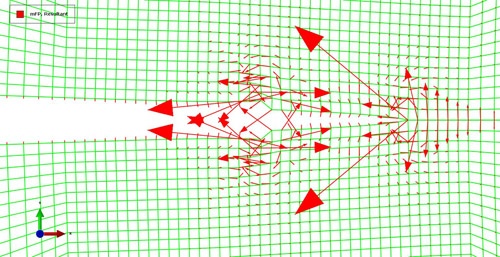
Configurational forces are thermodynamic forces that act on all types of defects (vacancies, dislocations, grain boundaries, voids, cracks) in materials. Configurational forces are induced also in regions that are plastically deformed; the magnitude of these configurational forces is proportional to the gradient of the plastic strain. An example, for the distribution of the configurational forces around the tip of an extending crack is presented in the figure. The configurational forces are computed by a post processing procedure after a conventional finite element stress and strain analysis.
If there several defects are present in a material, they interact with each other. Therefore the crack driving force is influenced by the presence of other defects. This has been taken into account by introducing an additional crack driving force term, denominated as “material inhomogeneity term” (Simha et al., 2003).We have used the concept of configurational forces also for the prediction of the behaviour of cracks in inhomogeneous materials and components, see e.g.Kolednik et al. (2010), and for the design of new, fracture resistant materials, e.g. Kolednik et al. (2014).
References:
N.K. Simha, F.D. Fischer, O. Kolednik, C.R. Chen, Inhomogeneity effects on the crack driving force in elastic and elastic-plastic materials. Journal of the Mechanics and Physics of Solids 51 (2003) 209-240.
N.K. Simha, F.D. Fischer, G.X. Shan, C.R. Chen, O. Kolednik, J-integral and crack driving force in elastic-plastic materials. Journal of the Mechanics and Physics of Solids 56 (2008) 2876-2895.
O. Kolednik, J. Predan, F.D. Fischer, Reprint of “Cracks in inhomogeneous materials: Comprehensive assessment using the configurational forces concept”. Engineering Fracture Mechanics 77 (2010) 3611-3624.
O. Kolednik, J. Predan, F.D. Fischer, P. Fratzl, Improvements of strength and fracture resistance by spatial material property variations, Acta Materialia 68 (2014) 279-294.
W. Ochensberger, O. Kolednik, A new basis for the application of the J-integral for cyclically loaded cracks in elastic‒plastic materials. International Journal of Fracture, submitted.
Journal Reference
International Journal of Fracture, Volume 187, Issue 1, pp 77-107. (2014).
O. Kolednik, R. Schongrundner, F. D. Fischer.
Erich Schmid Institute of Materials Science, Austrian Academy of Sciences, Jahnstrasse 12, 8700 , Leoben, Austria and
Materials Center Leoben Forschung GmbH, Roseggerstrasse 12, 8700 , Leoben, Austria and
Institute of Mechanics, Montanuniversität, Franz-Josef Strasse 18, 8700 , Leoben, Austria
Abstract
It is well known that the application of the conventional J -integral is connected with severe restrictions when it is applied for elastic–plastic materials. The first restriction is that the J -integral can be used only, if the conditions of proportional loading are fulfilled, e.g. no unloading processes should occur in the material. The second restriction is that, even if this condition is fulfilled, the J -integral does not describe the crack driving force, but only the intensity of the crack tip field. Using the configurational force concept, Simha et al. (J Mech Phys Solids 56:2876–2895, 2008), have derived a J -integral, Jep , which overcomes these restrictions: Jep is able to quantify the crack driving force in elastic–plastic materials in accordance with incremental theory of plasticity and it can be applied also in cases of non-proportionality, e.g. for a growing crack. The current paper deals with the characteristic properties of this new J -integral, Jep , and works out the main differences to the conventional J -integral. In order to do this, numerical studies are performed to calculate the distribution of the configurational forces in a cyclically loaded tensile specimen and in fracture mechanics specimens. For the latter case contained, uncontained, and general yielding conditions are considered. The path dependence of Jep is determined for both a stationary and a growing crack. Much effort is spent in the investigation of the path dependence of Jep very close to the crack tip. Several numerical parameters are varied in order to separate numerical and physical effects and to deduce the magnitudes of the crack driving force for stationary and growing cracks. Interpretation of the numerical results leads to a new, completed picture of the J -integral in elastic–plastic materials where Jep and the conventional J -integral complement each other. This new view allows us also to shed new light on a long-term problem, which has been called the “paradox of elastic–plastic fracture mechanics”.