Advances in Engineering Advances in Engineering features breaking research judged by Advances in Engineering advisory team to be of key importance in the Engineering field. Papers are selected from over 10,000 published each week from most peer reviewed journals.

Significance Statement
Journal Reference
J. Climate, 26, 6561–6574. (2013).
Feldman, Daniel R., Daniel M. Coleman, William D. Collins.
Earth Sciences Division, Lawrence Berkeley National Laboratory, Berkeley, California &
Department of Earth and Planetary Science, University of California, Berkeley, Berkeley, California.
ABSTRACT
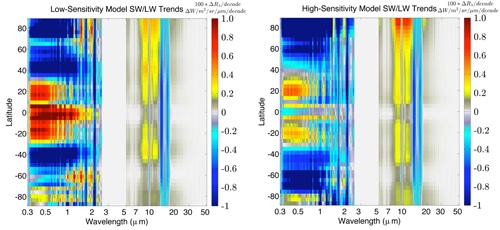
Top-of-atmosphere radiometric signals associated with different high- and low-cloud–radiative feedbacks have been examined through the use of an observing system simulation experiment (OSSE). The OSSE simulates variations in the spectrally resolved and spectrally integrated signals that are due to a range of plausible feedbacks of the climate system when forced with CO2 concentrations that increase at 1% yr−1. This initial version of the OSSE is based on the Community Climate System Model, version 3 (CCSM3), and exploits the fact that CCSM3 exhibits different cloud feedback strengths for different model horizontal resolutions. In addition to the conventional broadband shortwave albedos and outgoing longwave fluxes, a dataset of shortwave spectral reflectance and longwave spectral radiance has been created. These data have been analyzed to determine simulated satellite instrument signals of poorly constrained cloud feedbacks for three plausible realizations of Earth’s climate system produced by CCSM3. These data have been analyzed to estimate the observational record length of albedo, outgoing longwave radiation, shortwave reflectance, or longwave radiance required to differentiate these dissimilar Earth system realizations. Shortwave spectral measurements in visible and near-infrared water vapor overtone lines are best suited to differentiate model results, and a 33% difference in shortwave–cloud feedbacks can be detected with 20 years of continuous measurements. Nevertheless, at most latitudes and with most wavelengths, the difference detection time is more than 30 years. This suggests that observing systems of sufficiently stable calibration would be useful in addressing the contribution of low clouds to the spread of climate sensitivities currently exhibited by the models that report to the Intergovernmental Panel on Climate Change (IPCC).