Advances in Engineering Advances in Engineering features breaking research judged by Advances in Engineering advisory team to be of key importance in the Engineering field. Papers are selected from over 10,000 published each week from most peer reviewed journals.

Journal Reference
European Polymer Journal, Volume 49, Issue 12, December 2013, Pages 3788-3795.
Emna Chichti, Matthieu George, Jean-Yves Delenne, Farhang Radjai, Valérie Lullien-Pellerin.
INRA, UMR 1208, Ingénierie des Agropolymères et Technologies Emergentes, F-34060 Montpellier Cedex 01, France and
Laboratoire Charles Coulomb, UMR 5221, CNRS-UM2, Place Eugène Bataillon, F-34095 Montpellier Cedex, France and
Laboratoire de Mécanique et Génie Civil, UMR 5508, CNRS-UM2, Place Eugène Bataillon, F-34095 Montpellier, France
Abstract
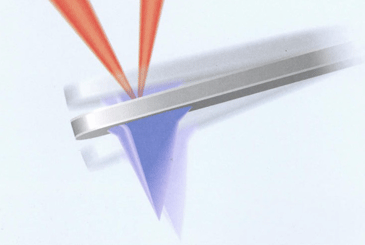
An original method based on atomic force microscopy (AFM) in contact mode was developed to abrade progressively the surface of tablets made of starch or gluten polymers isolated from wheat. The volume of the material removed by the tip was estimated from the analysis of successive topographic images of the surface, and the shear force was measured by keeping a constant normal force. Our data together with a simple tribological model provide clear evidence for a higher hardness and shear strength of starch compared to gluten. Gluten appears to have mechanical properties close to soft materials, such as talc, whereas starch displays higher hardness close to calcite. Our results are in a better agreement with structural properties of gluten (complex protein network) and starch (granular and semi-cristalline structure) than earlier studies by micro-indentation. This work shows that the AFM scratching method is relevant for the characterization of any polymer surface, in particular in application to materials made of different polymers at the nano-scale.