Advances in Engineering Advances in Engineering features breaking research judged by Advances in Engineering advisory team to be of key importance in the Engineering field. Papers are selected from over 10,000 published each week from most peer reviewed journals.

APL Mat. 2, 021101 (2014).
Koushik Ghosh1, Eva Rose M. Balog1, Prakash Sista1, Darrick J. Williams1,Daniel Kelly2, Jennifer S. Martinez1,a, Reginaldo C. Rocha1,a
1 Center for Integrated Nanotechnologies, Materials Physics and Applications Division, Los Alamos National Laboratory, Los Alamos, New Mexico 87545, USA and
2 Chemistry Division, Los Alamos National Laboratory, Los Alamos, New Mexico 87545, USA.
Abstract
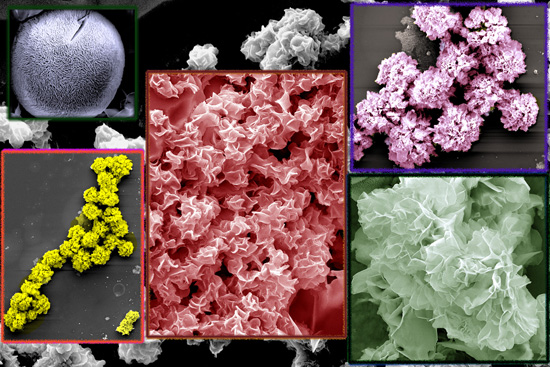
We report a method for creating hybrid organic-inorganic “nanoflowers” using calcium or copper ions as the inorganic component and a recombinantly expressed elastin-like polypeptide (ELP) as the organic component. Polypeptides provide binding sites for the dynamic coordination with metal ions, and then such noncovalent complexes becomenucleation sites for primary crystals of metal phosphates. We have shown that the interaction between the stimuli-responsive ELP and Ca2+ or Cu 2+, in the presence of phosphate, leads to the growth of micrometer-sized particles featuring nanoscale patterns shaped like flower petals. The morphology of these flower-like composite structures is dependent upon the temperature of growth and has been characterized by scanning electron microscopy. The composition of nanoflowers has also been analyzed by energy-dispersive X-ray spectroscopy,X-ray photoelectron spectroscopy, and X-ray diffraction. The temperature-dependent morphologies of these hybrid nanostructures, which arise from the controllable phase transition of ELPs, hold potential for morphological control of biomaterials in emerging applications such as tissue engineering and biocatalysis.