Advances in Engineering Advances in Engineering features breaking research judged by Advances in Engineering advisory team to be of key importance in the Engineering field. Papers are selected from over 10,000 published each week from most peer reviewed journals.

Significance Statement
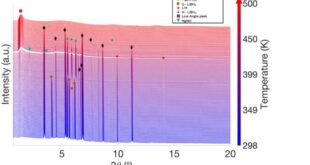
To prepare RGO thin-film electrodes containing the oxygen functional group, a simple fabrication process by (ⅰ) dropping and evaporating the graphene oxide (GO) solution, (ⅱ) irradiating intensive pulsed lights, and then (ⅲ) heat-treating at 200, 240, 310, and 360 °C was applied. It was notable that the pulsed flash-light irradiation was effective to form and maintain some pathways for taking off residual water molecules without disfiguring the deposited GO thin-film during the thermal reduction.
From XPS O 1s spectra analyses, for all RGO thin-films after thermal reductions at 200 to 360 °C, the atomic percentage of carboxyl and phenol groups were sustained as 5.40±0.36 and 4.77±0.41 at% respectively. But, for carbonyl and quinone groups, atomic percentages were gradually declined from 3.10 to 1.81 and from 1.32 to 0.65 at% respectively, as increasing the thermal reduction temperature.
Assuming as (i) no other functional groups but four oxygen functional groups of carboxyl, phenol, carbonyl, and quinone in the RGO thin-films contribute to the pseudocapacitance and (ii) the electric double layer capacitance in either 6 M KOH or 1 M H2SO4 is the same as in 0.5 M Na2SO4, the specific pseudocapacitance per unit atomic percentage for either carboxyl or phenol group in 6 M KOH was obtained as 12.59 F g-1 at%-1. For carbonyl group in 1 M H2SO4, it was a slightly deviated value of 13.55 F g-1 at%-1 from that of carboxyl or phenol. For quinone group in 1 M H2SO4, it was 27.09 F g-1 at%-1.

Figure 1 Legend. Schematic diagram of preparing RGO electrode.
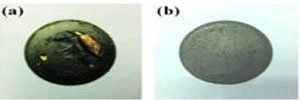
Figure 2 Legend. Photographs of thermally treated GO at 200 °C without pulsed flash-light irradiations (a) and with pulsed flash-light irradiations (b).
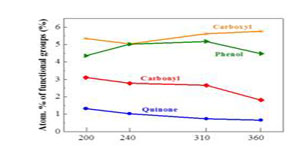
Figure 3 Legend. Variations of atomic percentages for RGOs as increasing thermal reduction temperature.
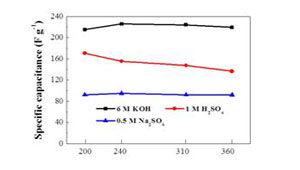
Figure 4 Legend. Specific capacitances at scan rate of 5 mV s-1 for RGO electrodes as increasing thermal reduction temperature.
Journal Reference
Electrochimica Acta, Volume 116, 2014, Pages 118–128.
Young Joon Oh a, b, Jung Joon Yooa, Yong Il Kima, Jae Kook Yoona, Ha Na Yoona, Jong-Huy Kima, Seung Bin Parkb,
a Energy Storage Department, Korea Institute of Energy Research (KIER), #152 Gajeong-ro, Yuseong-gu, Daejeon, 305-343, Republic of Korea
b Department of Chemical and Biomolecular Engineering, Korea Advanced Institute of Science and Technology (KAIST), #291 Daehak-ro, Yuseong-gu, Daejeon, 305-701, Republic of Korea
Abstract
For incompletely reduced graphene oxides (RGOs), an effect of oxygen functional groups such as carboxyl, phenol, carbonyl, and quinone on electrochemical capacitive behavior was studied. To prepare RGO thin-film electrodes, a simple fabrication process by (i) dropping and evaporating the graphene oxide (GO) solution, (ii) irradiating pulsed light, and (iii) heat-treating at 200 ∼ 360 °C was applied. It was notable that the pulsed light irradiation was effective to prevent the disfiguring of deposited GO thin-film during the thermal reduction. From XRD analyses, interlayer distances of the RGOs were gradually decreased from 0.379 to 0.354 nm. As increasing the thermal reduction temperature from 200 to 360 °C, XPS O 1s spectra analyses showed that the atomic percentages of carboxyl and phenol of the RGOs were sustained as 5.40 ± 0.36 and 4.77 ± 0.41 at% respectively. Meanwhile, those of carbonyl and quinone of the RGOs were gradually declined from 3.10 to 1.81 and from 1.32 to 0.65 at% with different thermal reduction temperature respectively. For all RGO thin-film electrodes, the specific capacitance from the CV measurement in 6 M KOH was sustained as ca. 220 F g−1 at the scan of 5 mV s−1. However, in 1 M H2SO4, the specific capacitance was gradually decreased from 171 to 136 F g−1. After 100,000 cycles in 6 M KOH, 1 M H2SO4, and 0.5 M Na2SO4, the RGO (200 °C) electrodes showed ca. 92, 54, and 104% of the initial capacitances respectively. The atomic percentages of the oxygen functional groups involved in the pseudocapacitive Faradaic reaction were decreased after the cycle test. Especially in 1 M H2SO4, quinone group was decreased to ca. 48% of initial atomic percentage, which seems to be a main reason for the drastic reduction of capacitance. The specific pseudocapacitance per unit atomic percentage for either carboxyl or phenol group in 6 M KOH was obtained as 12.59 F g−1 at%−1. For carbonyl group in 1 M H2SO4, it was a slightly deviated value as 13.55 F g−1 at%−1. For quinone group in 1 M H2SO4, it was 27.09 F g−1at%−1.