Advances in Engineering Advances in Engineering features breaking research judged by Advances in Engineering advisory team to be of key importance in the Engineering field. Papers are selected from over 10,000 published each week from most peer reviewed journals.

Significance Statement
The present study was performed by Ajit Mishra in his PhD research work [1-4] under the guidance of Dr. Dave Shoesmith at University of Western Ontario (Canada). Currently, Ajit Mishra is working as a Staff Engineer-Corrosion at Haynes International (Indiana, US) and his work primarily focusses on alloy development, failure analysis and testing of corrosion-resistant nickel-based alloys used in various industries.
The effects of major alloying elements (Cr, Mo and W) on the crevice corrosion inhibition of a number of commercial Ni-Cr-Mo (W) alloys were studied in aggressive chloride solution using a novel electrochemical technique [5, 6]. As expected, Cr is the key element determining resistance to crevice initiation but a substantial Mo or Mo+W content is required to achieve maximum film stability. At very high Mo (Mo + W) contents, grain boundary pitting was eliminated and only a generally distributed shallow propagation occurred, consistent with the widespread distribution of molybdates and tungstates.
[2]. A.K. Mishra, S. Ramamurthy, M. Biesinger and D.W. Shoesmith, Electrochimica Acta, 100, (2013), p. 118.
[3]. A.K. Mishra and D.W. Shoesmith, Electrochimica Acta, 102, (2013), p. 328.
[4]. A.K. Mishra and D.W. Shoesmith, Corrosion 2015 (submitted), NACE, Dallas: TX, March 15-19 2015.
[5]. A.K. Mishra and G.S. Frankel, Corrosion, 64 (11), (2008), p. 836
[6]. A.K. Mishra and G.S. Frankel, Proceedings of Mat. Sci. & Tech. (MS&T), 11, (2007), p. 939.
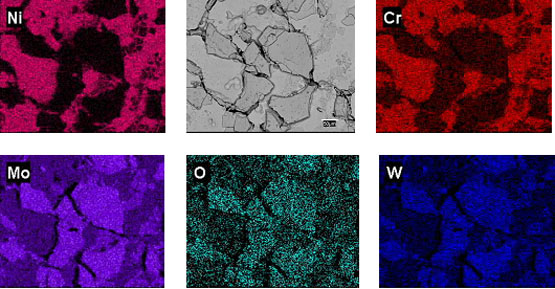
Figure 1. SEM micrograph and EDX maps of the crevice corroded region on alloy 686
Corrosion: July 2014, Vol. 70, No. 7, pp. 721-730.
A.K. Mishra* and D.W. Shoesmith‡,*,**
Abstract
The effects of Cr, Mo, and W on the crevice corrosion of a number of commercial Ni-Cr-Mo(W) alloys in 1.0 mol/L sodium chloride (NaCl) were studied using the potentiodynamic-galvanostatic-potentiodynamic technique to measure film breakdown and repassivation potentials as well as protection temperatures. As expected, Cr is the key element determining resistance to crevice initiation, but a substantial Mo alloy content is required to achieve maximum film stability, especially at temperatures >60°C. Mo, not Cr, is the major element controlling crevice propagation and repassivation. If the protection temperature is accepted as the key indicator of overall alloy resistance, then the resistance increases in the order: Alloy 625 (UNS N06625) < C-4 (UNS N06455) < C-276 (UNS N10276) < C-22 (UNS N06022) ~ Alloy 59 (UNS N06059) ~ C-2000 (UNS N06200) < Alloy 686 (UNS N06686). More generally, this order could be written: high Cr-low Mo < low Cr-high Mo < high Cr-high Mo < high Cr-high (Mo+W). The individual influences of Mo and W appear to be inseparable and, while adding W improved the resistance, adding the equivalent amount of Mo could achieve the same