Advances in Engineering Advances in Engineering features breaking research judged by Advances in Engineering advisory team to be of key importance in the Engineering field. Papers are selected from over 10,000 published each week from most peer reviewed journals.

Nanoscale Res Lett. 2014 Apr 13;9(1):181.
Tan CL, Jang SJ, Song YM, Alameh K, Lee YT.
Advance Photonic Research Institute, Gwangju Institute of Science and Technology, 1 Oryong-dong, Buk-gu, Gwangju 500-712, Republic of Korea. [email protected].
Abstract
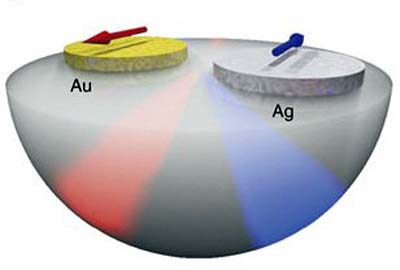
We propose the use of bimetallic non-alloyed nanoparticles (BNNPs) to improve the broadband optical absorption of thin amorphous silicon substrates. Isolated bimetallic NPs with uniform size distribution on glass and silicon are obtained by depositing a 10-nm Au film and annealing it at 600°C; this is followed by an 8-nm Ag film annealed at 400°C. We experimentally demonstrate that the deposition of gold (Au)-silver (Ag) bimetallic non-alloyed NPs (BNNPs) on a thin amorphous silicon (a-Si) film increases the film’s average absorption and forward scattering over a broad spectrum, thus significantly reducing its total reflection performance. Experimental results show that Au-Ag BNNPs fabricated on a glass substrate exhibit resonant peaks at 437 and 540 nm and a 14-fold increase in average forward scattering over the wavelength range of 300 to 1,100 nm in comparison with bare glass. When deposited on a 100-nm-thin a-Si film, Au-Ag BNNPs increase the average absorption and forward scattering by 19.6% and 95.9% compared to those values for Au NPs on thin a-Si and plain a-Si without MNPs, respectively, over the 300- to 1,100-nm range.