Advances in Engineering Advances in Engineering features breaking research judged by Advances in Engineering advisory team to be of key importance in the Engineering field. Papers are selected from over 10,000 published each week from most peer reviewed journals.

Significance Statement
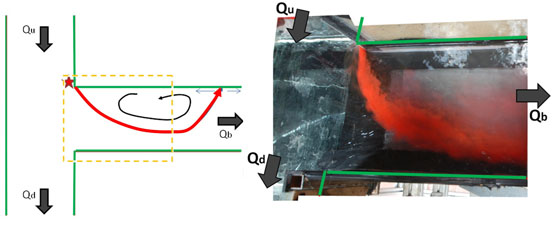
The new mathematical formulation proposed in the paper, using a frame-axis based on the local velocity field, permits to better estimate the characteristics of the mixing layer taking place between the mean flow and the recirculation zone, as sketched on the figure below. Among these characteristics is the intensity of the exchanges between both regions: the material exchanged can be sediments, pollutants, chemical material, nutriments, gazes, etc. The photo below shows a short-time release of dye injected just upstream from the bifurcation corner and reveals that: i) the width of the colored layer extends towards downstream and ii) part of the dye enters the recirculation zone. Indeed, the dye is transported transversally towards both sides of the separating streamline (the blue line on the sketch) through coherent structures which influence is enlighten by using the new formulation detailed in the paper.
Figure. Left: Sketch of an open-channel bifurcation with the green area representing the area of the photo; Right: photo of dye release at the upstream corner (with water depth h=4cm and upstream discharge Qu=4L/s).
Journal of Hydraulic Engineering, Volume 140, Issue 3 (2014).
Emmanuel Mignot1, Delphine Doppler2, Nicolas Riviere3, Ivana Vinkovic4, Jean-Noel Gence5, Serge Simoens6
1LMFA, CNRS-Université de Lyon, INSA de Lyon, Université Claude Bernard Lyon 1, 69621 Villeurbanne, Ecole Centrale de Lyon (corresponding author). E-mail: [email protected] and
2LMFA, CNRS-Université de Lyon, INSA de Lyon, Université Claude Bernard Lyon 1, 69100 Villeurbanne, Ecole Centrale de Lyon.and
3LMFA, CNRS-Université de Lyon, INSA de Lyon, Université Claude Bernard Lyon 1, 69621 Villeurbanne, Ecole Centrale de Lyon.and
4LMFA, CNRS-Université de Lyon, INSA de Lyon, Université Claude Bernard Lyon 1, 69100 Villeurbanne, Ecole Centrale de Lyon.and
5LMFA, CNRS-Université de Lyon, INSA de Lyon, Université Claude Bernard Lyon 1, 69100 Villeurbanne, Ecole Centrale de Lyon.and
6LMFA, CNRS-Université de Lyon, INSA de Lyon, Université Claude Bernard Lyon 1, 69130 Écully, Ecole Centrale de Lyon.
ABSTRACT
The motivation for the present work comes from the fact that a few recent publications describing separation flows report a counter-gradient diffusion phenomenon (CDP) along the separating streamline. This CDP is related to (1) a change of sign of the Reynolds shear stress near the separating point and (2) an opposite sign between the Reynolds shear stress and the mean shear rate, leading to a negative eddy-viscosity coefficient. Such CDP is only reported for configurations where the angle between the separating streamline and the main flow is large (referred to as group 1), whereas no CDP was reported for low angle configurations (referred to as group 2). All these flows were analyzed using Cartesian or curvilinear frame axes. The aim of the present paper is to propose a more intuitive frame for analysis, namely the Serret-Frenet frame axis based on the local flow direction, for which the CDP disappears for group 1 flow configurations and that highly improves the characterization of the mixing layer. The recirculation zone occurring in the lateral branch of an open-channel bifurcation is chosen as a separating flow configuration belonging to group 1 and measured using particle image velocimetry (PIV). The characteristics of the mean flow and of the horizontal Reynolds stress are first analyzed using a Cartesian frame axis, to retrieve the CDP, for which extension is enhanced compared with the literature cases. Then, the local Serret-Frenet frame axis is introduced and used for a second analysis of the data. The flow characteristics at the interface between the main flow and the recirculation zone accurately match the characteristics of the well-documented mixing layers available in the literature. Moreover, the eddy-viscosity concept nicely applies using this Serret-Frenet frame axis. A simple geometrical analysis is finally performed to confirm that the negative eddy-viscosity coefficient obtained when using a Cartesian frame axis is only attributable to a nonadequate frame of analysis.