Advances in Engineering Advances in Engineering features breaking research judged by Advances in Engineering advisory team to be of key importance in the Engineering field. Papers are selected from over 10,000 published each week from most peer reviewed journals.

Dyes and Pigments volume 98, issue 2, august 2013, pages 201–211.
Tânia Moniza, Carla Queirósa, Rita Ferreiraa, Andreia Leitea, Paula Gameiroa, Ana M.G. Silvaa ,
Maria Rangelb
a REQUIMTE, Departamento de Química e Bioquímica, Faculdade de Ciências, Universidade do Porto, 4169-007 Porto, Portugal and
b REQUIMTE, Instituto de Ciências Biomédicas Abel Salazar, Universidade do Porto, 4099-003 Porto, Portugal.
Abstract
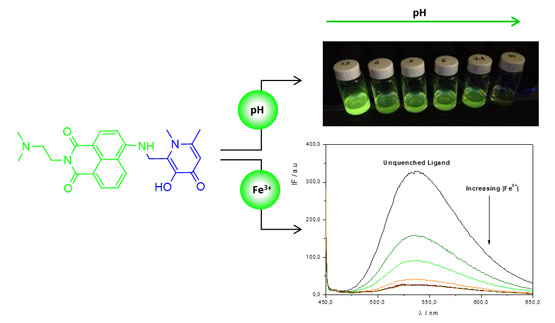
The synthesis and sensing properties of a new fluorescent probe designed to have a 4-amino-1,8-naphthalimide fluorescent platform functionalized with a 3-hydroxy-4-pyridinone bidentate chelating unit at the 4-position and a terminal aliphatic dimethylamino group at the imide site, are reported. The absorption and fluorescence properties of the ligand were investigated in DMSO and in aqueous solution at variable pH and in the presence of increasing concentration of Fe3+, Cu2+ and Zn2+.
Analysis of the UV–Vis spectra at variable pH allowed the determination of three pKa values (pKa1 = 3.19, pKa2 = 8.38, pKa3 = 9.95) and establishment of the corresponding speciation diagram. Fluorescence spectra obtained in the same conditions show that the fluorescence intensity of the probe decreases with increasing pH and are off above pH 9 as a result of photo-induced electron transfer arising from the aliphatic dimethylamino group. Under physiological pH conditions, the probe shows an absorption band centred at 439 nm and emits in the green at λ = 536 nm.
Analysis of UV–Vis and EPR spectra of the ligand in the presence of Fe3+ and Cu2+ is consistent with the formation of the corresponding metal ion complexes. The fluorescence intensity of the ligand is quenched in the presence of variable concentrations of Fe3+, Cu2+ and Zn2+ and under physiological pH conditions the fluorescence of the probe is ca 92%, 88% and 91% quenched in the presence of Fe3+, Cu2+ and Zn2+respectively.