Significance Statement
In expensive clean and renewable energy materials are in immediate need for green energy applications. Among the various available energy sectors, the solar energy industry is one the fastest growing in the market for future generation energy needs. Particularly photovoltaic (PV) systems those directly convert the solar energy into electrical energy is are useful for solar energy development. The photovoltaic technologies have advanced for more than a century after the discovery of the photoelectric effect by Einstein. However, after decades of development, the commercialized crystalline silicon solar panels are still too expensive to compete with fossil energy. Photovoltaic (PV) devices provide a promising platform for harvesting solar energy to generate electricity and thereby contribute to environmentally safer fuel. In order to lower the energy harvesting costs, various photovoltaic cells such as thin as thin film amorphous silicon solar cells, copper indium gallium selenide solar cells, dye-sensitized solar cells, cadmium telluride solar cells, quantum dot solar cells, organic solar cells, perovskite solar cells etc. are under intense study. About a half century ago, the ferroelectric photovoltaic effect was discovered in a variety of ferroelectric materials in which a steady photovoltaic response (photovoltage and photocurrent) can be generated along the polarization direction. Generally, the ferroelectric photovoltaic effect originates from the spontaneous electric polarization in ferroelectric materials. The photovoltaic effect in ferroelectric thin films has attracted considerable interest to fulfill this requirement. Unlike the photovoltaic effect observed in a semiconductor p-n junction, the photovoltaic effect in ferroelectrics does not require an asymmetric interface and photo-voltage is not limited by the band gap of the material. Non-centrosymmetry in the unit cell might be the reason for photovoltaic effect in ferroelectric materials, which gives rise to asymmetries in electron excitation, relaxation, and scattering processes. The photovoltaic effect in ferroelectric materials is relied on the polarization-induced internal electric field. Polarization mediated photovoltaic properties in BiFeO3 thin films have been reported by several research groups. By suitable site engineering at Bi and Fe-sites, one can observe improvement ferroelectric photovoltaic properties by suppressing the significant leakage current behavior. Transition metal modified polycrystalline BiFeO3 (BFO) thin films with significant PV response is observed under illumination both in sandwich and lateral electrode configurations. Photovoltaic behavior was demonstrated in Bi0.9Sm0.1Fe0.95Co0.05O3 (BSFCO) thin films under illumination in sandwich electrode configuration for both polarizations up state and down state. Large open-circuit voltage (Voc)~0.9V and with a small short-circuit current (Jsc) ~ −0.051μAcm−2 for the polarization up state by applying a positive voltage pulse is obtained for these Bi0.9Sm0.1Fe0.95Co0.05O3 (BSFCO) films.
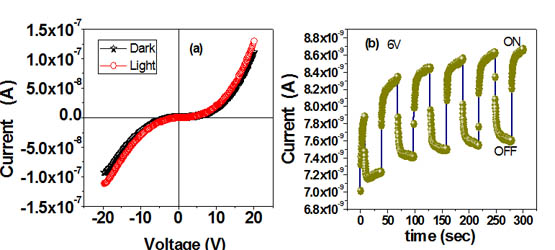
Fig. (a) The dark and illuminated I-V curves in sandwich electrode configuration for the polarization down state by applying a negative voltage pulse (b) Variation of current as a function of time upon turning the light on and off for Bi0.9Sm0.1Fe0.95Co0.05O3 (BSCFO) thin films.

Journal of Physics D: Applied Physics Volume 47 Number 7, 2014.
Venkata Sreenivas Puli1,2,6, Dhiren Kumar Pradhan2, Rajesh Kumar Katiyar2, Indrani Coondoo3, Neeraj Panwar4, Pankaj Misra2, Douglas B Chrisey1, J F Scott2,5 and Ram S Katiyar2
[expand title=”Show Affiliations”]
1 Department of Physics and Engineering Physics, Tulane University, New Orleans LA 70118, USA and
2 Department of Physics and Institute of Functional Nanomaterials, University of Puerto Rico, San Juan-00936, PR, USA and
3 Department of Ceramics and Glass Engineering and CICECO, University of Aveiro, 3810-193 Aveiro, Portugal and
4 Department of Physics, Central University of Rajasthan, Bandar Sindri, Rajasthan 305801, India and
5 Cavendish Laboratory, Dept. Physics, University of Cambridge, Cambridge CB0 3HE, UK and
6 Author to whom any correspondence should be addressed.
[/expand]
Abstract
We report photovoltaic (PV) effect in multiferroic Bi0.9Sm0.1Fe0.95Co0.05O3 (BSFCO) thin films. Transition metal modified polycrystalline BiFeO3 (BFO) thin films have been deposited on Pt/TiO2/SiO2/Si substrate successfully through pulsed laser deposition (PLD). PV response is observed under illumination both in sandwich and lateral electrode configurations. The open-circuit voltage (Voc) and the short-circuit current density (Jsc) of the films in sandwich electrode configuration under illumination are measured to be 0.9 V and −0.051 µA cm−2. Additionally, we report piezoresponse for BSFCO films, which confirms ferroelectric piezoelectric behaviour.
Go To Journal of Physics D: Applied Physics
 Advances in Engineering Advances in Engineering features breaking research judged by Advances in Engineering advisory team to be of key importance in the Engineering field. Papers are selected from over 10,000 published each week from most peer reviewed journals.