Advances in Engineering Advances in Engineering features breaking research judged by Advances in Engineering advisory team to be of key importance in the Engineering field. Papers are selected from over 10,000 published each week from most peer reviewed journals.

Journal Reference
Advanced Functional Materials, Volume 25, Issue 28, pages 4548–4557, July 22, 2015.
Dong-Dong Han1, Yong-Lai Zhang1,*, Yan Liu2, Yu-Qing Liu1, Hao-Bo Jiang1, Bing Han1, Xiu-Yan Fu1, Hong Ding3, Huai-Liang Xu1 , Hong-Bo Sun1,4,*
[expand title=”Show Affiliations”]- State Key Laboratory on Integrated Optoelectronics, College of Electronic Science and Engineering, Jilin University, Changchun, China
- Key Laboratory of Bionic Engineering (Ministry of Education), Jilin University, Changchun, China
- State Key Laboratory of Inorganic Synthesis and Preparative Chemistry, College of Chemistry, Jilin University, Changchun, China
- College of physics, Jilin University, Changchun, China
Abstract
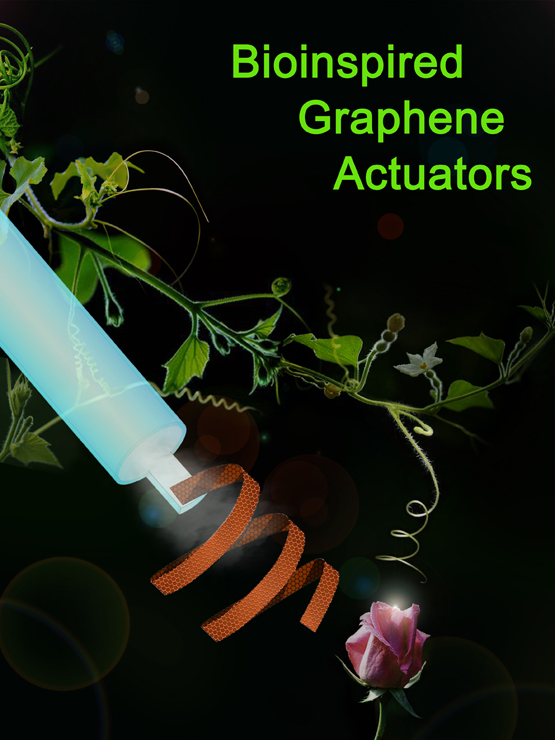
Inspired by natural autonomous systems that demonstrate controllable shape, appearance, and actuation under external stimuli, a facile preparation of moisture responsive graphene-based smart actuators by unilateral UV irradiation of graphene oxide (GO) papers is reported. UV irradiation of graphene oxide is found to be an effective protocol to trigger the reduction of graphene oxide; however, due to the limited light transmittance and thermal relaxation, thick graphene oxide paper cannot be fully reduced. Consequently, by tuning the photoreduction gradient, anisotropic GO/reduced GO (RGO) bilayer structure can be easily prepared toward actuation application. To get better control over the responsive properties, GO/RGO bilayer paper with a certain curvature and RGO patterns are successfully prepared for actuator design. As representative examples, smart humidity-driven graphene actuators that mimic the cilia of respiratory tract and tendril climber plant are successfully developed for controllable objects transport.
© 2015 WILEY-VCH Verlag GmbH & Co. KGaA, Weinheim.
Go To Advanced Functional Materials