Advances in Engineering Advances in Engineering features breaking research judged by Advances in Engineering advisory team to be of key importance in the Engineering field. Papers are selected from over 10,000 published each week from most peer reviewed journals.

Significance statement
Automation systems, such as sheet metal press lines for multi-stage stamping, face increasingly demanding requirements for the production rate. The automated control of the press lines is an important element that influences the production rate. The pre-programmed control specifies how the operations of the presses and the material handling robots in the line are synchronised. Typically, the same control code is reused to manufacture different sheet metal products. Due to the high investment cost, it is crucial to get a maximal production rate and consequently a maximal return on investment. To obtain a maximal production rate, the control should be tuned and optimised for each product. The current approach, i.e. manual trial and error by making ad hoc changes, is not reliable, it relies on the expertise of skilled operators and it is very time-consuming and costly. The physical size and power of the presses make manual online optimisation difficult and dangerous. Hence, there is a specific need for offline optimisation tools and support. Researchers from the research centre Production Technology West at University West in Trollhättan, Sweden, investigate methods and algorithms to support reprogramming and optimisation of the automated control of sheet metal press lines. The goal is to achieve automatic offline reprogramming and optimisation of the control of press lines, which would be very time- and cost-saving for the industry. In the research project, there is a close collaboration between University West and Volvo Cars Corporation in Olofström, Sweden. This allows the researchers to test their newly developed methods and algorithms on press lines in real-world scenarios. Thereby, the researchers are able to gain knowledge about the performance, applicability and robustness of their methods and algorithms in a real-world context. From the results of these real-world tests, the Volvo Cars Corporation gets a very reliable indication of the improvements with automatic reprogramming and optimisation.
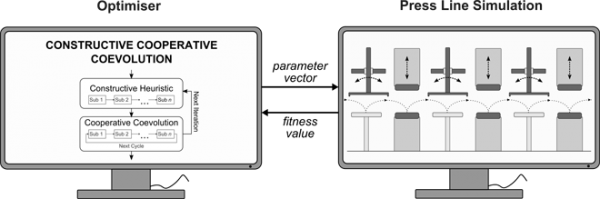
The article presents a novel evolutionary algorithm, named the Constructive Cooperative Coevolutionary (C3) algorithm which is specifically developed to increase the production rate by optimising the control and synchronisations of robots and presses. The proposed optimisation algorithm works in concert with a simulation model of the press line. Using a simulation model enables performing the optimisation offline without interrupting the production. The C3 algorithm was tested in a case study. Several sheet metal press lines from Volvo Cars Corporation that produce body panels for cars were optimised. The results show very significant improvements of the production rate for the press lines when using the C3 algorithm for offline simulation-based optimisation. In the article, it is also shown that the C3 algorithm outperforms other existing optimisation algorithms on other optimisation problems similar to the press line problem.
Journal Reference
The International Journal of Advanced Manufacturing Technology, September 2015, Volume 80, Issue 1, pp 673-688.
Emile Glorieux 1, Fredrik Danielsson1, Bo Svensson1, Bengt Lennartson2
[expand title=”Show Affiliations”]- Department of Engineering Science, University West, S-461 86, Trollhättan, Sweden
- Department of Signals and Systems, Chalmers University of Technology, S-412 96, Gothenburg, Sweden
Abstract
Optimisation of the control function for multiple automated interacting production stations is a complex problem, even for skilled and experienced operators or process planners. When using mathematical optimisation techniques, it often becomes necessary to use simulation models to represent the problem because of the high complexity (i.e. simulation-based optimisation). Standard optimisation techniques are likely to either exceed the practical time frame or under-perform compared to the manual tuning by the operators or process planners. This paper presents the Constructive cooperative coevolutionary (C3) algorithm, which objective is to enable effective simulation-based optimisation for the control of automated interacting production stations within a practical time frame. C3 is inspired by an existing cooperative coevolutionary algorithm. Thereby, it embeds an algorithm that optimises subproblems separately. C3 also incorporates a novel constructive heuristic to find good initial solutions and thereby expedite the optimisation. In this work, two industrial optimisation problems, involving interaction production stations, with different sizes are used to evaluate C3. The results illustrate that with C3, it is possible to optimise these problems within a practical time frame and obtain a better solution compared to manual tuning.
Go To The International Journal of Advanced Manufacturing Technology