Advances in Engineering Advances in Engineering features breaking research judged by Advances in Engineering advisory team to be of key importance in the Engineering field. Papers are selected from over 10,000 published each week from most peer reviewed journals.

Significance Statement
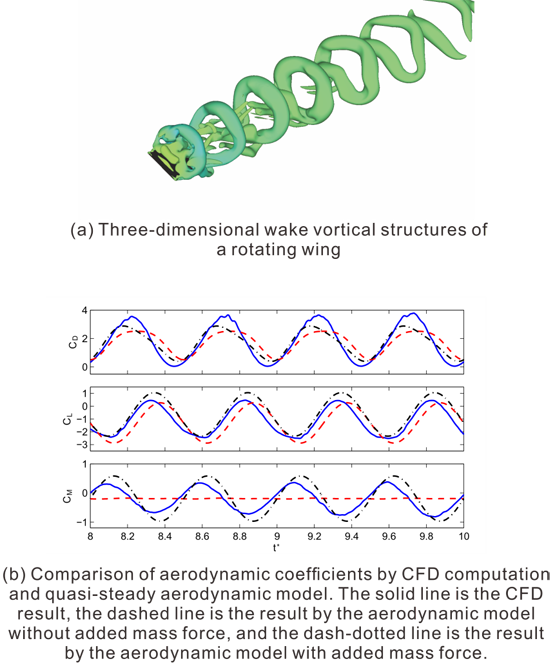
A thin plate rotating around an axis perpendicular to an airstream is an interesting physical phenomenon. In this work, a computational study on the three-dimensional flow past a rotating wing at a low Reynolds number has been performed for the first time. The complex unsteady flow structures and vortex shedding patterns have been demonstrated and discussed. Furthermore, a quasi-steady aerodynamic model is validated by comparing with the computational results. The mechanism of this problem may be applied in future energy harvesting engineering and needs further comprehensive study.
Journal Reference
Fluid Dynamics Research, Volume 47, Number 4, 2015.
Hu Ruifeng
School of Mechano-Electronic Engineering, Xidian University, Xi’an 710071, Peopleʼs Republic of China.
Abstract
In this work, we performed a computational study on the three-dimensional (3D) flow past a rotating wing at a low Reynolds number (Re = 200). The 3D vortical structures and aerodynamic performances of the rotating wing with different aspect ratios and rotating speeds are computed and analyzed. A quasi-steady model is adopted for prediction of aerodynamic performances of the wing, and its applicability is evaluated by the computation. It is found that there exists a periodic vortex shedding pattern at a low rotating speed, while vortices may cluster near the wing when rotating speed is high enough. The wake vortex topology is also affected by the aspect ratio. The current quasi-steady aerodynamic model could only be used for rotating wing aerodynamics at a low rotating speed when regularly periodic vortex shedding exists.
Go To Fluid Dynamics Research