![]()
About the author
Emeritus Professor Johannis Simitzis has served at the School of Chemical Engineering of National Technical University of Athens (NTUA) initially as Senior Assistant (1979-1982) and then as Lecturer (1982-1985), as Assistant Professor (1985-1990), as Associate Professor (1991-1997) as Professor (1997-2011) and from 2012 until today as Emeritus Professor. Previously, he worked as Scientific collaborator at the Institute of Chemical Technics of the University of Karlsruhe, Germany (1971-mid. 1975), as Special Scientist at the University of Thessaloniki (mid.1975-mid.1977) and as Laboratory- Director at the Industry “VIANIL”, Greece, (mid.1977-1978). He had been visiting Professor at the Polymer Physics / Technical University of Berlin (TH), Germany (1988, 1990-1993) and at the Deutsches Kunstsoff – Institut / Darmstadt, Germany (1988-1989). He had been the Director of the Interdepartmental Postgraduate Programme “Materials Science and Technology” from its constitution in 1997 until Sept. 2011 and vice president of the Senatorial Committee of the Postgraduate Programmes of NTUA (1999-2004). He obtained his Ph.D. (Dr.rer.nat.) degree from the University of Karlsruhe (TH), Germany in mid. 1975. He holds Diploma of Chemical Engineer from NTUA (1968) and Diploma of Business Administration from Economic University of Athens (ASOEE), (1971). The author’s expertise includes: Industrially produced polymers, Carbon Fibres, Nanostructured Carbon and Composites, Semiconducting Organic Polymers and Composites, Polymeric Carbons based on Precursors of Natural and Synthetic Polymers and Biomaterials / Biopolymers.
![]()
About the author
Dr. Pantelitsa Georgiou has served at the School of Chemical Engineering of National Technical University of Athens (NTUA) as Senior Assistant in Management and Administration Duties in Inter-disciplinary Postgraduate Programme of NTUA, “Materials Science and Technology” (2000-2014). She obtained her Ph.D. degree from NTUA in 2011 and during her studies she has undertaken tutorial activities and contributed to the Supervision of Laboratory Practices for Undergraduate and Postgraduate Students. Since June 2014 she serves as Scientific Instructional Laboratory Personnel. She holds Diploma of Chemical Engineer from NTUA (1998). The author’s expertise includes: Industrially produced polymers, Carbon Fibres, Nanostructured Carbon and Composites, Polymeric Carbons based on Precursors of Natural and Synthetic Polymers, Electrochemistry of Carbon and Inorganic Semiconductors.
Journal Reference
Journal of Materials Science, 2015, Volume 50, Issue 13, pp 4547-4564.
Chr. Simitzis, P. Chr. Georgiou
Laboratory of “Materials Science and Engineering”, Department III, School of Chemical Engineering, National Technical University of Athens, 9 Heroon Polytechiou Str., Zografou Campus, 157 73, Athens, Greece
Abstract
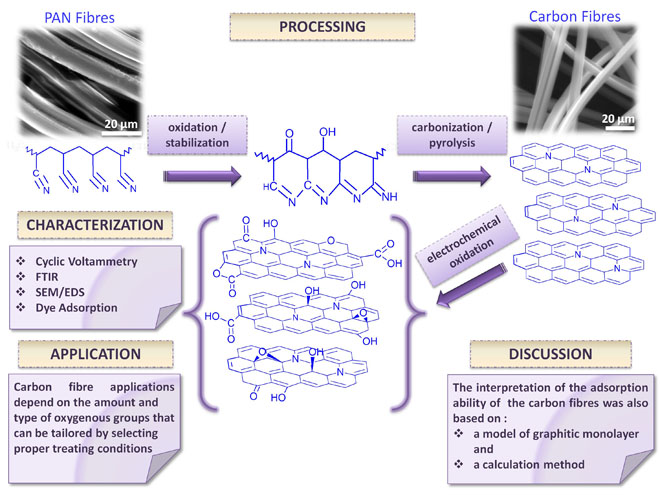
A unique consideration is intended, concerning the creation of functional groups during the production of carbon fibres from polyacrylonitrile, i.e. oxidation/stabilization, carbonization/pyrolysis and electrochemical modification processes and their role for applications. Acrylic fibres of homopolymer PAN are subjected to thermo-oxidative treatment following a four-stage or a two-stage isothermal programme, and the resulting oxidized fibres are pyrolyzed up to 1000 °C for 30 min or they are flash-pyrolyzed at 1000 °C for 5 min, and the shrinkage and weight loss are determined. According to FTIR spectra, two indices were expressed to follow the dehydrogenations and cyclizations (nitrile groups) and the band intensity of carbonyl groups to follow the oxidation. The carbon fibres produced from the four-stage oxidation were examined using SEM/EDS. Based on SEM/EDS analysis, an oxygen content of approx. 8.7 at.% in the fibres is needed for the stabilization of the fibres during the oxidation by a four-stage treatment up to 300 °C. These carbon fibres were electrochemically modified by Cyclic Voltammetry in narrow and wide potential regions, using aqueous H2SO4. The electrochemical treatment of carbon fibres in the wide region leads to the introduction of an additional amount of oxygen of about 5 at.%, exhibiting also acidic and basic groups in adequate amount. The formation of oxygenous groups on carbon fibres during the three processes is indirectly followed by their ability to adsorb methylene blue or alizarin yellow dyes, based on the concept of “acid–base interaction”. Considering a model of a graphitic monolayer of a basic square that includes 9 rings, the O atoms introduced in this segment were estimated. Carbon fibre applications depend on the amount and type of oxygenous groups that can be targeted by selecting proper treatment conditions.
Go To Journal of Materials Science
 Advances in Engineering Advances in Engineering features breaking research judged by Advances in Engineering advisory team to be of key importance in the Engineering field. Papers are selected from over 10,000 published each week from most peer reviewed journals.