Advances in Engineering Advances in Engineering features breaking research judged by Advances in Engineering advisory team to be of key importance in the Engineering field. Papers are selected from over 10,000 published each week from most peer reviewed journals.

Significance Statement
Light emitting diodes (LEDs) industry has been developing rapidly. The LED package has been applied to many areas which require illumination because of its electrical efficiency and reliability. The reliability of LED packages is evaluated through several tests such as room temperature operating life test (RTOL), high temperature operating life test (HTOL), low temperature life test (LTOL), wet high temperature operating life test (WHTOL), thermal shock test, mechanical shock test, and salt atmosphere test. Among several reliability tests, the lifetime tests are time-consuming because typically more than 2000 hours is necessary. One of the major failure modes during the tests is the lens or encapsulant crack, which results to lumen depreciation
Silicone polymers are used for encapsulant and lens for LED devices because of their high transparency, manufacturability, stable thermo-mechanical properties, and controlled refractive index. However, the silicone degradation is one of the major causes for degradation of LEDs. In this study, a key assumption was made that is the degree of the silicone degradation is strongly related to creep strain rate of the siloxane. Based on the assumption, silicone degradation during this life time test of LEDs was quantitatively evaluated using finite element analysis. In order to compute creep strain rate of the silicone, the linear viscoelastic properties of the silicone was measured and used for the FE thermal mechanical simulation. The creep strain rate of the silicone polymer was computed in a pre-defined volume of interest (VOI). Furthermore, the correlation between the computed creep strain rates and lumen depreciation could be established, which lead to a lumen depreciation model using the viscosity effect of the silicone. Based on this model, the tendency of the lumen maintenance for LED packages could be estimated using numerical analysis without time-consuming tests.

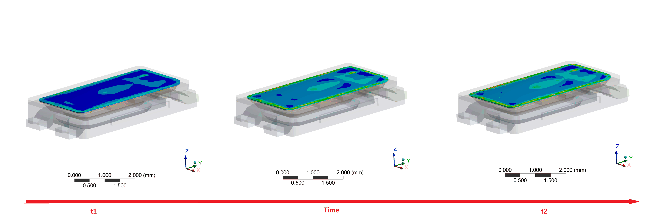
Figure Legend: An increment of creep strain in change of time for the predefined volume of interest (VOI)
Journal Reference
Microelectronics Reliability, Volume 55, Issue 12, Part B, December 2015, Pages 2678–2684.
Sung-Uk Zhang
Samsung Electronics Co., Ltd., 1, Samsung-ro, Giheung-gu, Youngin-si, Geonggi-do 446-711, South Korea.
Abstract
Light emitting diodes (LEDs) have been widely used for illumination because of their electrical efficiency and reliability. Their long lumen maintenance is not easy to be evaluated when it is compared with their efficiency because the reliability test is a time consuming task. LEDs are required to undergo many reliability tests and sometimes create failures induced by high thermo-mechanical stresses. One of the major failure modes is the lens or encapsulant crack. Therefore, the lens and encapsulant materials are required to contain high temperature stability as well as high optical properties. One of the materials for LEDs is polydimethylsiloxane (PDMS) which can have a wide range of refractive indices from 1.40 to 1.57. In this investigation, silicone degradation was quantitatively evaluated using finite element analysis. The finite element simulation showed that thermal–mechanical stress in volume of interest (VOI). As PDMS has viscoelastic properties, strain rates induced by the viscosity effect were focused and computed. Furthermore, the correlation between the strain rates and lumen depreciation was discovered, which leads to a lumen depreciation model based on the strain rates. Using the model, the tendency of the lumen maintenance for LED packages could be estimated using numerical analysis without time-consuming tests.
Go To Microelectronics Reliability