 Advances in Engineering Advances in Engineering features breaking research judged by Advances in Engineering advisory team to be of key importance in the Engineering field. Papers are selected from over 10,000 published each week from most peer reviewed journals.

Significance Statement
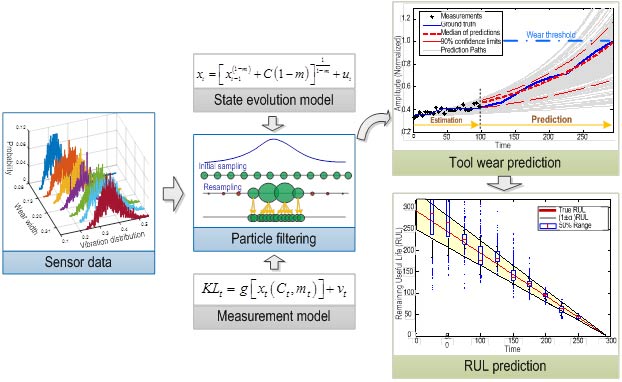
A Bayesian inference-based joint-state-and-parameter estimation method for tool wear prediction and remaining useful life (RUL) prediction using particle filtering (PF) is presented in this work. To address the sample degeneracy and impoverishment problem due to discrete approximation of probability distributions, which is inherent to particle filtering, an adaptive resampling method has been developed. Continuous approximation is achieved by dispersing the particles in the resampling process from fixed positions to a wider search range according to the particles’ performance, while maintaining a balance between keeping particle diversity (a degree to quantify unique and active particles) and ensuring particles’ tracking performance (diverse particles may increase the confidence interval of the estimation, leading to reduced estimation accuracy). Following this strategy, particles have shown to gradually concentrate on the optimal estimation, reducing the confidence interval associated with the estimation and prediction. In addition, the computational complexity of the developed method has been quantitatively analysed.
The developed method has been experimentally evaluated using a set of benchmark data (provided by the PHM Society), which were measured on a high-speed CNC machine under dry-milling operation. A force sensor and an accelerometer sensor have been used to monitor the process. The Kullback-Leibler divergence of the sensor data have been extracted as a feature, which is then taken by particle filtering as input to determine the tool wear evolution model. Good prediction has been confirmed by comparison between the predicted tool wear and actual tool wear measured offline by microscope. The findings demonstrated better performance of the adaptive resampling-based particle filtering developed in this work than that of the standard particle filtering.
This work complements another paper shown below, in which performance degradation of aircraft engines under varying degradation rates and abrupt faults has been studied.
- Wang and R. Gao, Markov Nonlinear System Estimation for Engine Performance Tracking, ASME Journal of Engineering for Gas Turbine and Power, 2016, published online. DOI: 10.1115/1/4032680.


Journal Reference
Journal of Manufacturing Systems, Volume 37, Part 2, 2015, Pages 528-534.
Peng Wang, Robert X. Gao
Department of Mechanical and Aerospace Engineering, Case Western Reserve University, Cleveland, OH 44106.
Abstract
Trending analysis has been widely investigated for prediction of tool wear, which impacts not only tool life but also the quality of machined products. This paper presents a Bayesian approach to predicting the flank wear rate, linking vibration data measured during machining with the state of tool wear. Variations in the measured data are aggregated based on the Kullback–Leibler divergence, which provides a measure for the distance between the current and initial probability distributions of measurement, when no wear is present. Subsequently, state space estimation of the tool wear is realized by particle filtering (PF), a non-linear and non-Gaussian system estimation technique. To overcome the sample impoverishment problem in sequential importance resampling (SIR), a new resampling scheme is proposed, which has shown to more reliably quantify the confidence interval and improve the prediction accuracy of the remaining useful life (RUL) prediction of the tool as compared to standard SIR method. The developed method is experimentally evaluated using a set of benchmark data measured from a high speed CNC machine that performed milling operations. Good results are confirmed by the comparison between the predicted tool wear state and off-line tool wear measurement.
Go To Journal of Manufacturing Systems