 Advances in Engineering Advances in Engineering features breaking research judged by Advances in Engineering advisory team to be of key importance in the Engineering field. Papers are selected from over 10,000 published each week from most peer reviewed journals.

Significance Statement
Date palms are cultivated since approximately 6000 B.C. The date fruit is one of the sweetest fruits around and also happens to come in many different varieties. Dates are rich in many vital nutrients like, Potassium, copper, fiber, Magnesium, Manganese and Vitamin B6, therefore offer many health benefits. The fruit is so small that larger quantity is required to intake the necessary amount. Unfortunately, this important fruit crop is under threat due to highly invasive pest, the red palm weevil (RPW) (Rhynchophorus ferrugineus).
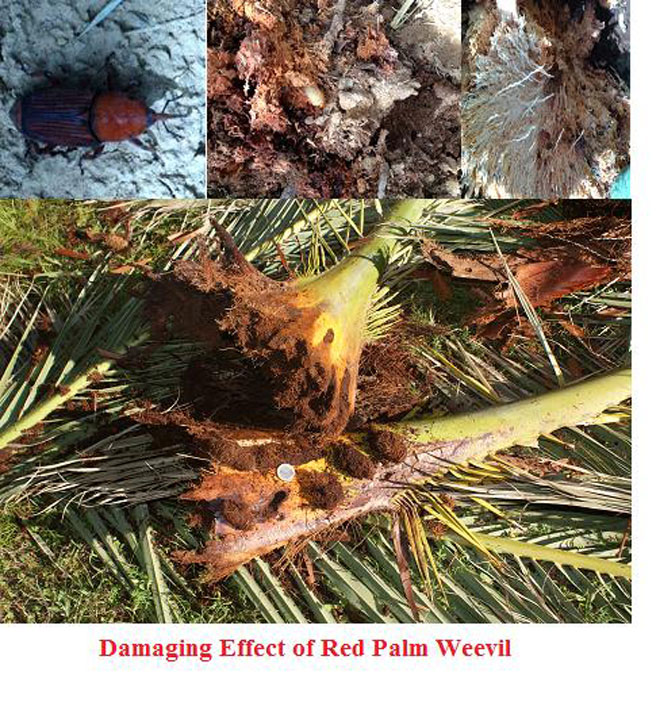
The red palm weevil (RPW), Rhynchophorous ferrugineus Oliver (Coleoptera: Curculionidae) is a serious pest of date palm and has been classified by Food and Agriculture Organization of the United Nations (FAO) as a category-1 pest in the Middle-East. The picture of the red palm weevil demonstrate that how red palm weevil damages the inner fiber of the tree. The growth of larval stage takes about two months while pupal stage takes about three weeks to adult emergence. The life of adult weevils is around 2 to 3 months. Red palm weevil infestation symptoms appear at later stages when it’s too late to recover the palm tree. Failure in early detection of red palm weevil infestation is the major obstacle in its successful management. Several techniques, such as acoustic sensors, visual inspections, acoustic sensors, sniffer dogs and pheromone traps have been implemented for the detection of red palm weevil infestation at early stages; however, each method has suffered certain logistic and implementation issues. Visual detection is based on the symptoms that appear at latter stage of infestation when the recovery chances of the infested plant are almost negligible. Pheromone detection is based on the placement of pheromone traps in the orchard for trapping any adult red palm weevil. This method only indicates the presence or absence of Red palm weevil in an orchard but cannot identify the infestation of individual tree. Acoustic detection method is based on the chowing and moving sounds produced by larvae inside tree trunk. But difficulty in this method is to discriminate between red palm weevil larvae sounds from plant sounds, other insect sounds and background noise
It has been noticed in the infested plants that red palm weevil excrete liquid when they chew on the fiber of the trunk. The wetness must travel down to the roots of the palm. On this belief, we have applied laser-induced breakdown spectroscopy (LIBS) technique on the soil around the roots of the palm for early identification of red palm weevil infestation.
LIBS is a type of emission spectroscopy which involves high energy focused laser pulse for the production of plasma from the target. The emitted light from the plasma after cooling is collected with an optical fiber and passed through a spectrograph to record the LIBS spectra. The spectra are analyzed to identify the elemental concentration of the target sample. This technique can be applied on any form of physical state of matter, solid, liquid, or gas. Molecular spectra can also be observed with this technique but it is less sensitive when compared to atomic lines.
From analysis of the observed LIBS spectra of different infested and healthy samples, we have found presence of Ca, Mg, Na, C, K elements and OH, CN molecules. The spectra also reveal that with the population growth of pest, the intensity of Mg and Ca atomic lines in LIBS spectra increases rapidly. Similar behavior is observed in the molecular lines of OH and CN on LIBS spectra. The obtained results indicate that LIBS technique can be used for the early detection of red palm weevil infestation without damaging the date palms. Improvement in the early detection of red palm weevil infestation with LIBS technique is still in progress in different condition and atmosphere.

Journal Reference
Plasma Science and Technology, Volume 17, Number 11 (2015)
A. Farooq1,K. G. Rasool2,Walid Tawfik1,3 and A. S. Aldawood2
[expand title=”Show Affiliations”]- Department of Physics and Astronomy College of Science, King Saud University, Riyadh 11451, Saudi Arabia
- Department of Plant Protection, College of Food and Agriculture Sciences, King Saud University, Riyadh 11451, Saudi Arabia
- Department of Environmental Applications, NILES National Institute of Laser, Cairo University, Cairo 12613, Egypt
Abstract
The Kingdom of Saudi Arabia is one of the leading date producing countries. Unfortunately, this important fruit crop is under great threat from the red palm weevil (RPW) (Rhynchophorus ferrugineus), which is a highly invasive pest. Several techniques, including visual inspection, acoustic sensors, sniffer dogs, and pheromone traps have been tried to detect the early stages of a red palm weevil infestation; however, each method has suffered certain logistical and implementation issues. We have applied laser induced breakdown spectroscopy (LIBS) for the early detection of RPW infestation. Through the analysis of the observed LIBS spectra of different infested and healthy samples, we have found presence of Ca, Mg, Na, C, K elements and OH, CN molecules. The spectra also reveal that with the population growth of the pest, the intensity of Mg and Ca atomic lines in LIBS spectra increases rapidly. Similar behavior is observed in the molecular lines of LIBS spectra. The obtained results indicate that the LIBS technique can be used for the early detection of red palm weevil infestation without damaging the date palms.
Go To Plasma Science and Technology