 Advances in Engineering Advances in Engineering features breaking research judged by Advances in Engineering advisory team to be of key importance in the Engineering field. Papers are selected from over 10,000 published each week from most peer reviewed journals.

Significance Statement
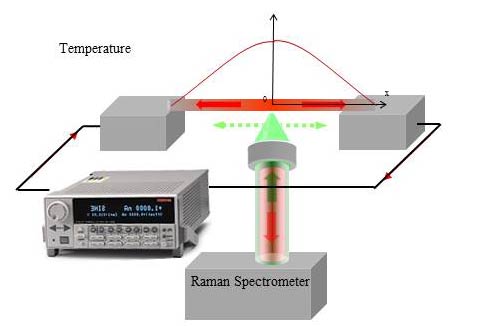
Thermal transport in one-dimensional structures has been studied extensively in the past two decades for the unique properties. Among different heat transfer modes, heat conduction and convection are of most important and are studied separately with different experimentations. However, they are coupled effects in thermal transport of low-dimensional materials especially at micro/nanoscale. The comprehensive study of the coupled effect requires a parallel measurement, which is still a challenge due to the limitation of characterization pathways. In this research, we report a novel method to study conductive and convective thermal transport of micro/nanowires simultaneously by using steady-state Joule-heating and Raman mapping. In this experimental setup, the wire is suspended between electrodes and supplied with joule heating. Under room environment, the heat dissipates along the sample to the electrodes via heat conduction and to the air through the sample surface via heat convection. The temperature profile along the sample represents the portion of heat conduction and convection, and thus, the corresponding thermophysical property can be characterized from the single temperature profile which can be monitored by simultaneous Raman mapping along the sample. To examine this method, a carbon nanotubes (CNTs) fiber is characterized for its thermal conductivity and convection coefficient with air. The temperature dependence of thermal properties of carbon nanotubes fiber including thermal conductivity and convection coefficient is studied. This method features a fast/convenient way for parallel measurement of both heat conduction and convection which is beneficial to comprehensively understanding the coupled effect in micro/nanoscale heat transfer. It can not only be employed to directly measure thermophysical property of low dimensional materials, but also be used for analyzing physical fundamentals in thermal transport under different environment.

Journal Reference
Appl. Phys. Lett. 106, 253108 (2015)
Man Li1, Changzheng Li1, Jianmei Wang1, Xiangheng Xiao2 , Yanan Yue1
[expand title=”Show Affiliations”]- School of Power and Mechanical Engineering, Wuhan University, Wuhan, Hubei 430072, China
- Department of Physics, Wuhan University, Wuhan, Hubei 430072, China
Abstract
Heat conduction and convection are coupled effects in thermal transport of low-dimensional materials especially at micro/nanoscale. However, the parallel measurement is a challenge due to the limitation of characterization pathways. In this work, we report a method to study conductive and convective thermal transport of micro/nanowires simultaneously by using steady-state Joule-heating and Raman mapping. To examine this method, the carbon nanotubes (CNTs) fiber (36 μm in diameter) is characterized and its temperature dependence of thermal properties including thermal conductivity and convection coefficient in ambient air is studied. Preliminary results show that thermal conductivity of the carbon nanotubes fiber increases from 26 W/m K to 34 W/m K and convection coefficient decreases from 1143 W/m2 K to 1039 W/m2 K with temperature ranging from 312 to 444 K. The convective heat dissipation to the air could be as high as 60% of the total Joule heating power. Uncertainty analysis is performed to reveal that fitting errors can be further reduced by increasing sampling points along the fiber. This method features a fast/convenient way for parallel measurement of both heat conduction and convection of micro/nanowires which is beneficial to comprehensively understanding the coupled effect of micro/nanoscale heat conduction and convection.
© 2015 AIP Publishing LLC
Go To Appl. Phys