Advances in Engineering Advances in Engineering features breaking research judged by Advances in Engineering advisory team to be of key importance in the Engineering field. Papers are selected from over 10,000 published each week from most peer reviewed journals.

Significance Statement
Up until now, small and mid-sized gas fields have been left undeveloped due to economic issues. Recently, however, Natural Gas Hydrate (NGH), that is expected to be more affordable than LNG in terms of the cost of building a supply chain, has drawn keen attention as a technical alternative.
In fact, research on technology related to NGH production and pelletizers has entered the phase of commercialization. Also, development of ships dedicated to long-distance bulk transportation of Natural Gas Hydrate Pellet (NGHP) has been pursued.
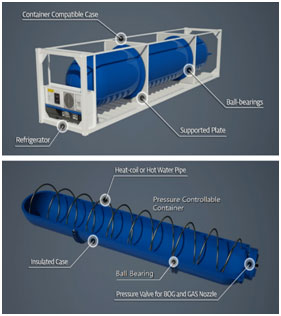
However, there exists a need to cut the cost of maritime transportation of NGH to secure the economic feasibility of developing small and medium gas fields. At the same time, technology related to the mid-stream supply chain is still in the development phase. In this regard, this paper was compiled to introduce the progress of a study on the technology for maritime transportation, unloading and re-gasification that utilizes the NGH tank container.
NGHP carriers for bulk transportation are posed with technical and economic limitations including excessive time required for loading and unloading caused by sintering, the need for the development of dedicated carriers and wharfs. Up until such constraints are resolved, the NGH tank container could be harnessed as a technical alternative for maritime transportation, unloading and re-gasification of NGH. It could also contribute to the development and verification of a range of technical solutions for establishing the supply chain.
Of course, a feasible technology that enables bulk transportation of NGH will be widely used at some point in the future. In such a case, the NGH tank container could be valued in alternation transport with common containers to supply energy to islands and cut the cost of building a supply chain. It could be also tapped into to improve the utilization of existing wharfs.

Journal Reference
Ocean Engineering, Volume 113, 1 February 2016, Pages 162-173.
Hee Jin Kang1, Youngsoon Yang2, Min Seok Ki1, Myung Soo Shin1, Jin Choi1,Jong-Ho Cha3,Dongkon Lee1
[expand title=”Show Affiliations”]- Advanced Ship Research Division/Korea Research Institute of Ships and Ocean Engineering, Republic of Korea
- Research Institute of Marine Systems Engineering, Seoul National University, Republic of Korea
- ORISE Postgraduate Program / National Energy Technology Laboratory,
Abstract
To date, small and midsized gas fields remain undeveloped due to economic issues. Recently, however, natural gas hydrate (NGH) has become expected to be more affordable than liquefied natural gas (LNG) in terms of the cost of establishing a supply chain over a certain range of transport distances from gas-fields and natural gas deposits. However, it is difficult to realize the economic benefit of NGH compared with LNG because the energy storage efficiency of NGH is relatively low. Therefore, the economic feasibility of concept designs for NGH pellet (NGHP) carriers should be evaluated before their commercialization. Other design alternatives should also be studied for additional cost reduction. In this paper, an NGH tank container is studied as a design alternative for cost-effective mid-stream supply chain establishment. For economic feasibility, the utilization of existing container ships, wharfs and other facilities is considered. Special attention is given to shortening long layovers and simplifying the regasification process. Because many small and midsized gas fields are distributed on the coast, the cost comparison assumes that natural gas is gathered to the land basis platform using a pipeline and is then formatted and pelletized for mass marine transportation.
Go To Ocean Engineering