Advances in Engineering Advances in Engineering features breaking research judged by Advances in Engineering advisory team to be of key importance in the Engineering field. Papers are selected from over 10,000 published each week from most peer reviewed journals.

Significance Statement
Our research highlights:
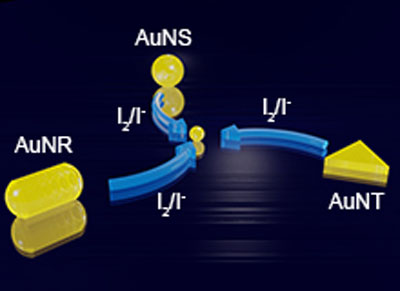
(1) By using scattered light dark-field microscopic imaging (iDFM) technique, the in situ KI/I2-treated etching processes on three shapes of AuNPs were monitored in real time. It was found that the scattered light of different shapes of AuNPs exhibited a noticeable color change and the scattered light spectra of AuNPs showed obvious blue-shifts with the decrease of scattered light intensity owing to the oxidation of Au atom into [AuI2] during the etching process.
(2) Both Finite-difference time-domain simulation and monitoring of morphological variations proved that the etching was a thermodynamics-dependent process, shows a chamfering coupled mechanism with layer-by-layer peeling, making the AuNPs at last degenerated into isotropic spheres together with the decrease of particle size.

Journal Reference
Shanshan Sun1,Mingxuan Gao1, Gang Lei 2, Hongyan Zou2, Jun Ma 1, Chengzhi Huang1,2
1. Key Laboratory of Luminescent and Real-Time Analytical Chemistry (Southwest University), Ministry of Education, College of Chemistry and Chemical Engineering, Southwest University, Chongqing, 400715, China
2. College of Pharmaceutical Sciences, Southwest University, Chongqing, 400716, China
[/expand]Abstract
Real-time monitoring of reaction processes is helpful for understanding the reaction mechanisms. In this study, we investigated the etching mechanism of gold nanoparticles (AuNPs) by iodine on a single-nanoparticle level because AuNPs have become important nanoprobes with applications in sensing and bioimaging fields owing to their specific localized surface plasmon resonance (LSPR) properties. By using a scattered-light dark-field microscopic imaging (iDFM) technique, the in situKI/I2-treated etching processes of various shapes of AuNPs, including nanospheres (AuNSs), nanorods (AuNRs), and nanotrigonal prisms (AuNTs), were monitored in real time. It was found that the scattered light of the different shapes of AuNPs exhibited noticeable color changes upon exposure to the etching solution. The scattering spectra during the etching process showed obvious blue-shifts with decreasing scattered intensity owing to the oxidation of Au atoms into [AuI2]–. Both finite-difference time-domain (FDTD) simulations and monitoring of morphological variations proved that the etching was a thermodynamic-dependent process through a chamfering mechanism coupled with layer-by-layer peeling, resulting in isotropic spheres with decreased particle sizes.
Go To Nano Research