Advances in Engineering Advances in Engineering features breaking research judged by Advances in Engineering advisory team to be of key importance in the Engineering field. Papers are selected from over 10,000 published each week from most peer reviewed journals.

Significance Statement
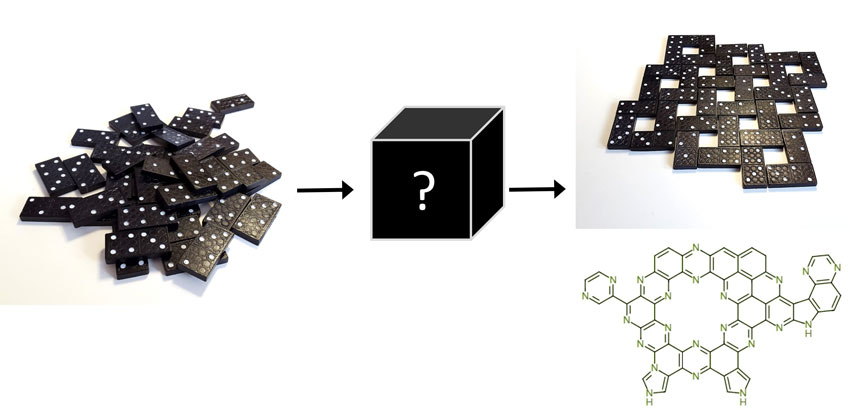
The targeted synthesis of functional carbons remains one of the big challenges. This is mainly related to the common necessity of high temperature treatments which essentially hinders external control during main parts of the synthesis. One possibility is the “encoding of functionality” in the precursors, i.e. final properties can already be determined through the choice of precursor. From phenol/ketone molecules and urea preorganized intermediate states are obtained, which can be further converted into nitrogen-containing carbons with unusually high, defined nitrogen content after thermal treatment. This is rather described by a controlled condensation than a pyrolysis process. All analysis is in line with a framework constituted, besides defects, only of aromatic carbon and pyrazinic nitrogen.
Especially nature offers an entire world of similar molecules and would thus make a library of functional materials accessible on a sustainable base. Such Nanoarchitectonics are not only relevant from a fundamental materials design point of view but also for applications such as catalysis, energy storage and adsorption.

Journal Reference
Adv. Mater. 28: 1287–1294. (2016)
Nina Fechler, Niels P. Zussblatt, Regina Rothe, Robert Schlögl, Marc-Georg Willinger, Bradley F. Chmelka, Markus Antonietti.
Max Planck Institute of Colloids and Interfaces, Department of Colloid Chemistry, Research Campus Golm, Potsdam, Germany
Abstract
Mixtures of phenols/ketones and urea show eutectic behavior upon gentle heating. These mixtures possess liquid-crystalline-like phases that can be processed. The architecture of phenol/ketone acts as structure-donating motif, while urea serves as melting-point reduction agent. Condensation at elevated temperatures results in nitrogen-containing carbons with remarkably high nitrogen content of mainly pyrazinic nature.
Go To Advanced Materials